Entries Tagged as 'California'
Posted by The Tim on May 27th, 2008 at 9:07 AM · 56 Comments
The March Case-Shiller Home Price Index came in fairly close to, but slightly worse than the NWMLS statistics for the same month.
Down 0.9% February to March.
Down 4.4% YOY.
According to Case-Shiller, home prices in Seattle have now declined a total of 7.3% from their July 2007 peak, and have retreated to just above where they were in June 2006.
In related news, if you are looking for a laugh, check out this recent column over at Inman News: Put a gag on Chicken Little. In it, the author actually tries to argue with a straight face that Case-Shiller is the least accurate gauge of home prices. Her “logic” is centered on the fact that data from Case-Shiller shows larger price drops than indices from OFHEO (which includes refinancing and only conforming loans), the NAR (you know how trustworthy they have proven themselves to be), and Realogy (parent company of Century 21, ERA, Coldwell Banker, and Sotheby’s International Realty—definitely no bias there, either), so obviously Case-Shiller must be incorrect. Heh.
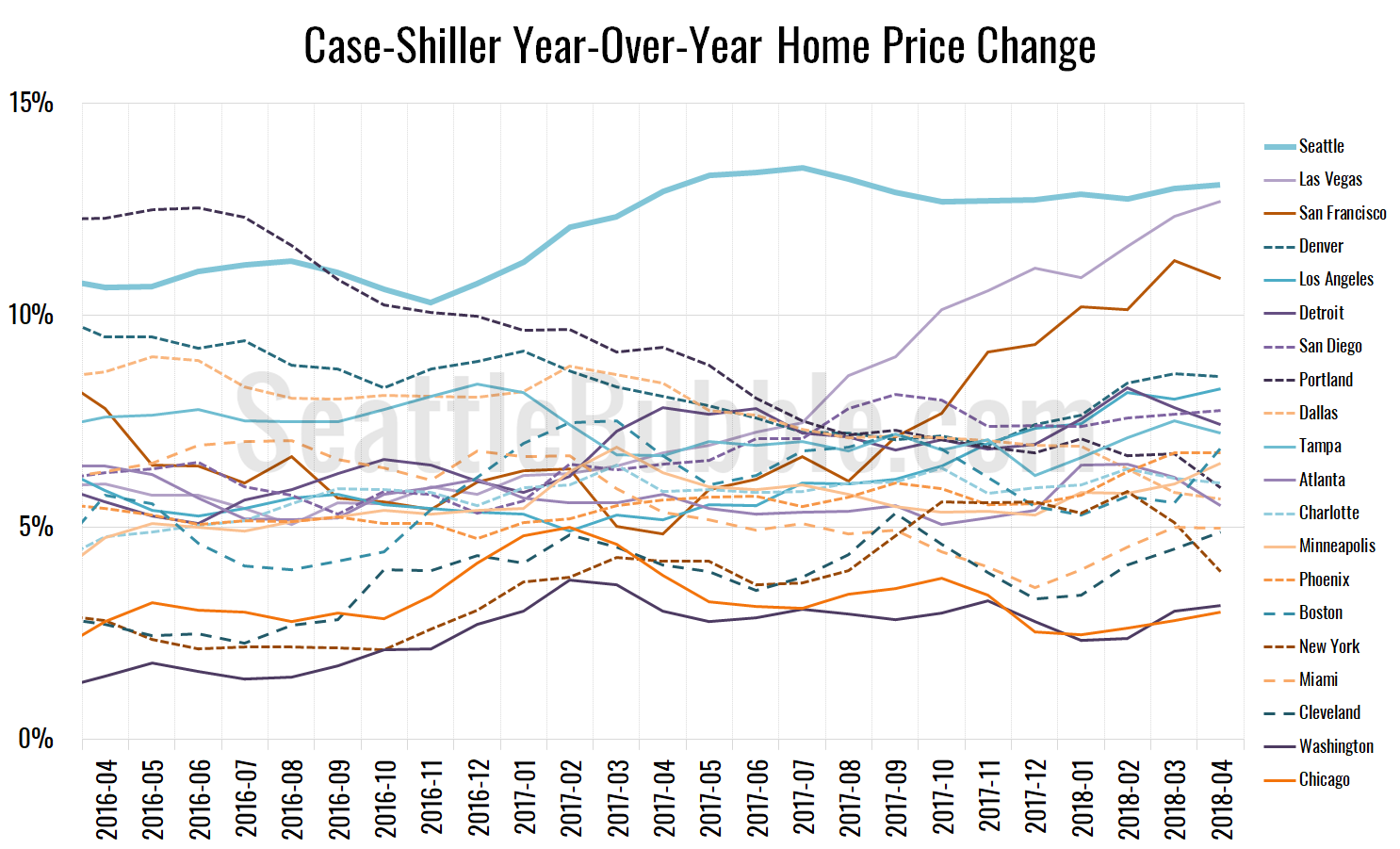
Here’s the usual graph, with L.A. & San Diego offset from Seattle & Portland by 17 months. Portland’s YOY drops nearly caught up with Seattle in March, coming in just over 4% to Seattle’s 4.4%. The vertical axis on most of these graphs had to be expanded, due to the continued declines in cities such as San Diego and Miami, now topping 20% YOY, and 25% total decline from the peak (with still no sign of slowing).

Click to enlarge
And here’s the graph of all twenty Case-Shiller-tracked cities:

Click to enlarge
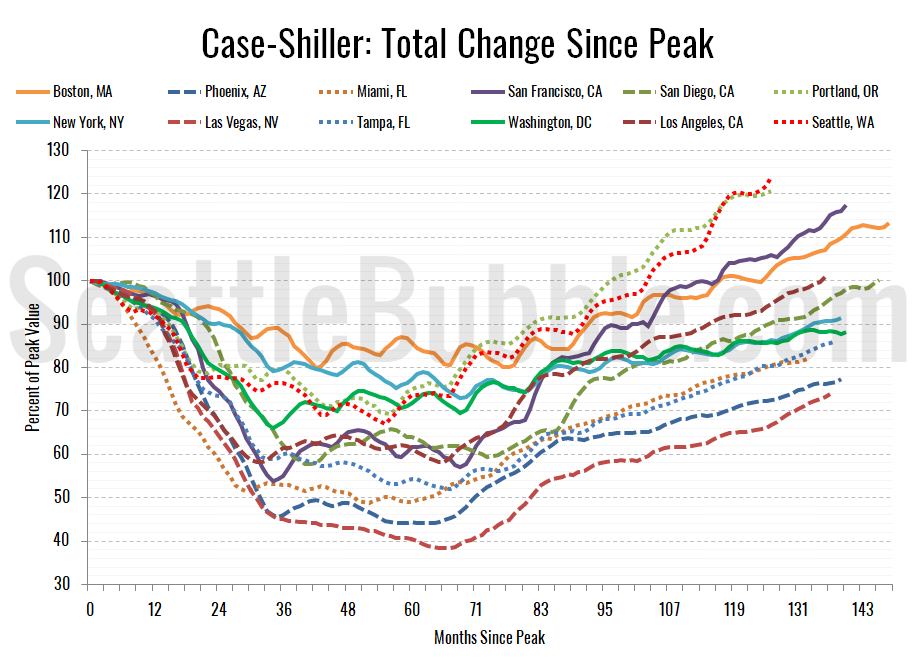
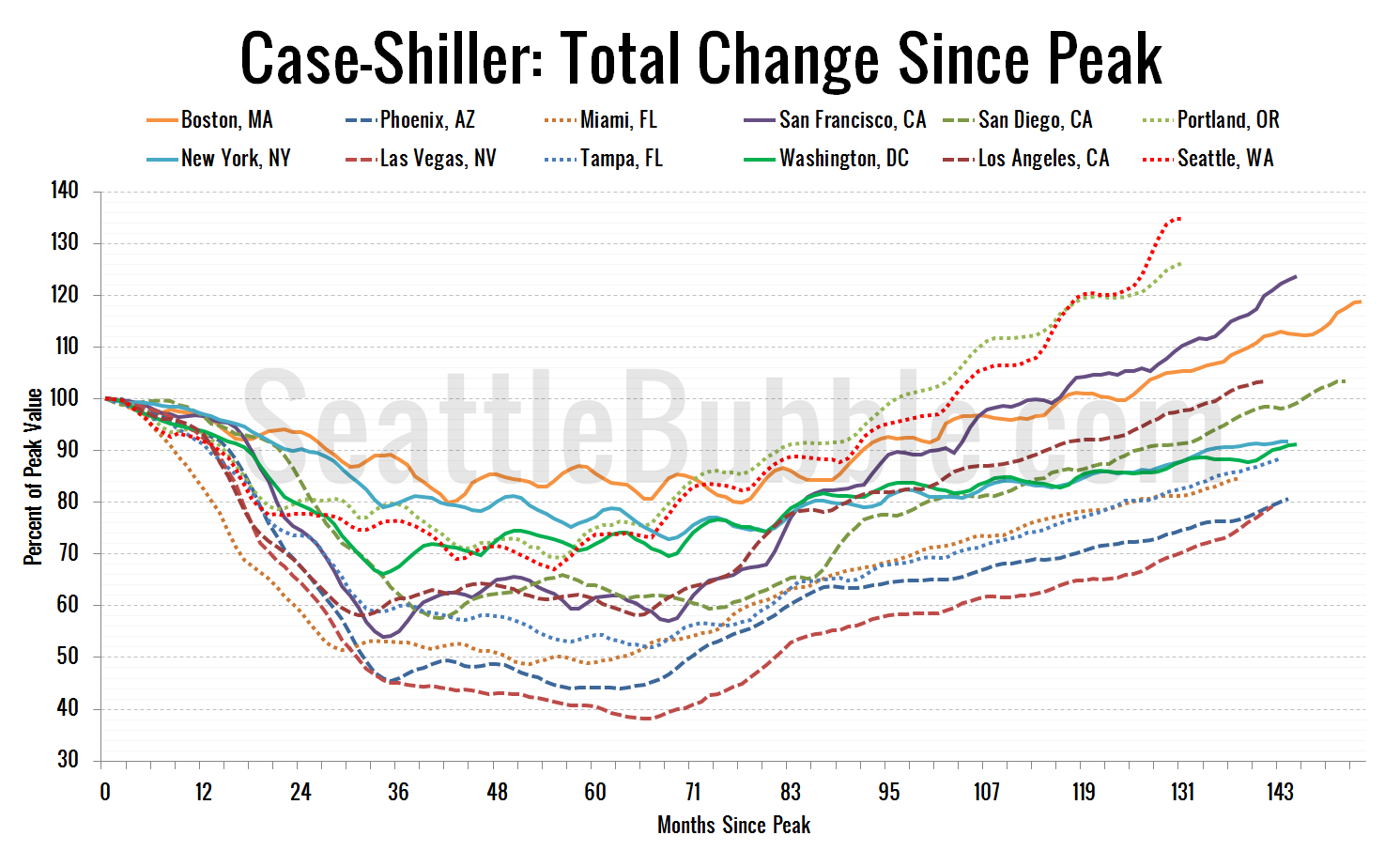
Here’s an update to the peak-decline graph, inspired by a graph created by reader CrystalBall. This chart takes the twelve cities whose peak index was greater than 175, and tracks how far they have fallen so far from their peak. The horizontal axis shows the total number of months since each individual city peaked.

Click to enlarge
8 months into home price declines, Seattle has shed 7.3% off the peak. At this point in San Diego’s decline, prices were down a whopping 0.5%, San Francisco was down about 3%. They have now seen a total decline of 26% and 23%, respectively.
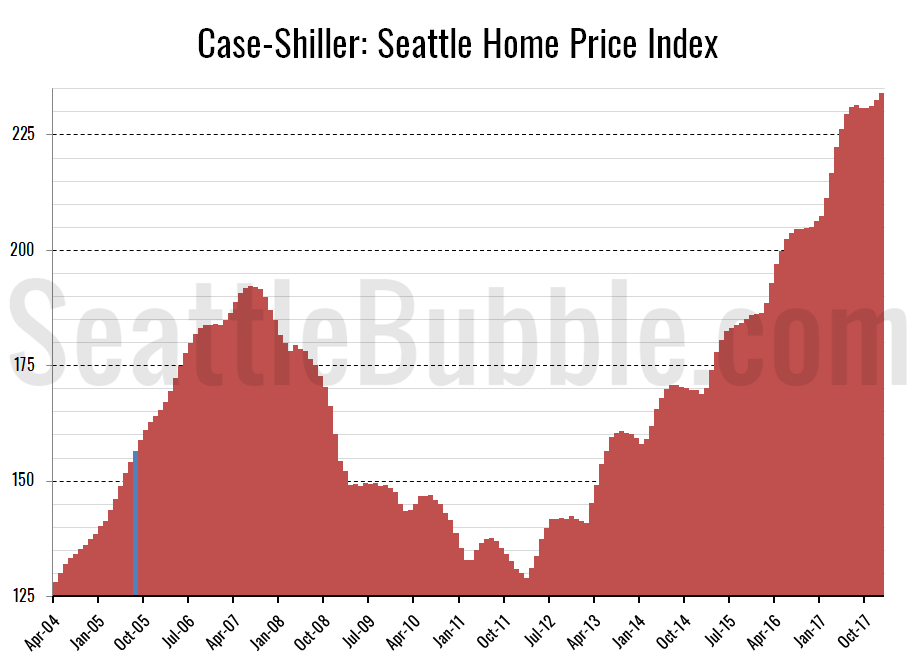
Here’s the “rewind” chart I introduced last month. The horizontal range is selected to go back just far enough to find the last time that Seattle’s HPI was as low as it is now. This gives us a clean visual of just how far back prices have retreated in terms of months.

Click to enlarge
Prices have been rewound approximately 21 months to June 2006. In the 8 months since Seattle’s peak prices, 13 months of price gains have been wiped out.
One thing I hear a lot is that price drops will never get as “bad” here as they will in Florida or California. I agree with that assertion. However, even if we take that as a given, we won’t really know anything about where Seattle’s bottom will be until we finally see a bottom in Florida and California. San Diego and Miami are down 26% so far, but who is to say they won’t continue dropping until they reach 50% off? They’re certainly not showing any sign of leveling off any time soon. If that were to happen, prices in Seattle could drop “only” 35-40% (which would put us at 2003 prices) and still not be as “bad” as Florida or California. A scenario like that seems entirely plausible to me.
Check back tomorrow for a post on the Case-Shiller data for Seattle’s price tiers.
(Home Price Indices, Standard & Poor’s, 05.27.2008)
Update: Here’s the Aubrey Cohen’s P-I story on the data. Apparently Elizabeth Rhodes at the Times is too busy today to do anything more than add a single sentence to the AP story.
Categories: Statistics
Tags: behind the cycle, California, Case-Shiller, Statistics
Posted by The Tim on May 20th, 2008 at 6:15 AM · 36 Comments
I thought it would be fun to check back in with an update on the San Diego / King County home price comparison I made back in March.
As of the latest Case-Shiller data (February) home prices San Diego have fallen 24% from their November 2006 peak. The Seattle area has dropped 6.5% from its July 2007 peak.
April median price for all homes sold (single-family + condos):
Both counties had an anemic spring bounce of sorts, but that didn’t stop aggregate home prices in San Diego County from falling below King County, thanks to a huge drop in March. Here’s an update of the graph from March, based on the following two supposedly realistic assumptions:
- King County home prices will remain flat through December.
- San Diego County home prices will continue to decline, at roughly half the rate they have dropped in the last six months.

Click to enlarge
The gap has widened since March, and those assumptions now lead to an 11% price difference by the end of the year. But of course San Diego doesn’t have any tech jobs, and their economy is basically in the toilet, so that makes perfect sense. Wait, neither of those statements is true at all.
Categories: Statistics
Tags: California, median, predictions, Statistics
Posted by The Tim on March 20th, 2008 at 10:38 AM · 117 Comments
Here’s an interesting comparison.
As of December’s Case-Shiller data, prices in San Diego County have fallen nearly 20% from their November 2005 peak. As of last month, their median price for all homes sold (single-family and condos) was $415,000 (source: San Diego Union-Tribune).
In the Seattle area, December’s Case-Shiller put prices off 4% from their July 2007 peak. Last month the median price for all homes sold in King County was $395,000 (source: NWMLS).
Now, if you listen to the so-called real estate “experts” around here, they will tell you that prices here in Seattle are just going to “plateau” and stay flat for a while, before continuing their ever-upward journey to the stars. On the other hand, no one in their right mind believes that San Diego’s price drops are over yet, given the continued severity of the foreclosure problem down there.
So let’s project the rest of this year for King County and San Diego County based on two allegedly reasonable assumptions:
- King County home prices will remain flat through December.
- San Diego County home prices will continue to decline, at roughly half the rate they have dropped in the last six months.
Here’s what that would look like:

Click to enlarge
If those two predictions were to hold true, homes in sunny San Diego will be seven percent cheaper than here in King County by the end of the year. I’m probably just ignorant of how super-great-awesome the Seattle area truly is, but to me, that doesn’t seem very likely. I predict that if such a turnaround does take place, it won’t last long once people realize that they can move back to California and buy a home for less money than in Seattle.
Categories: Statistics
Tags: California, median, predictions, Statistics
Posted by The Tim on October 11th, 2007 at 9:06 AM · 63 Comments
A couple people pointed me to a great article in today’s Wall Street Journal on the prevalence of sub-prime lending across the country over the last few years. The article discusses the surge in such risky loans, and the fallout that is already underway and likely to continue.
The data suggest that financial suffering is likely to persist in many parts of the U.S. where subprime lending had surged. Many loans at risk of going bad have not yet done so. As much as $600 billion of adjustable-rate subprime loans, for example, are due to adjust to higher rates by the end of 2008, which means that more and more borrowers are likely to fall behind.
Attached to the article is a nifty interactive graphic that shows just how widespread subprime lending has become since 2004. Here’s a bit about the methodology they used:
High-rate loans are defined as those having an annual percentage rate of at least three percentage points above a Treasury security of comparable maturity for first-lien loans and five percentage points for second-lien loans. Lenders have been required to report pricing details on high-rate loans since 2004. High-rate loans are considered to include many, but not all, subprime loans.
So how does the Seattle area stack up? Obviously we didn’t have nearly the amount of sub-prime lending as other parts of the country, such as Miami, Orlando, Las Vegas, or Los Angeles, where sub-prime made up over 30% of all mortgages in 2006. But we still experienced plenty of a “surge” of our own:
2004

2005

2006

Yup, sub-prime lending more than doubled as a percentage of the total mortgage market in the Seattle area. Tacoma was even worse, clocking in with 31% of all loans being sub-prime in 2006, earning them special mention in the WSJ article.
Lest you think that 20% is a low enough number to keep us out of trouble when the appreciation music stops, consider San Diego’s sub-prime stats for the same period (2004-2006): 8.1%, 19.1%, 22.7%. So no, sub-prime lending itself does not precipitate the decline of home prices. But once home prices do start to decline, even having 10-20% of recent mortgages being sub-prime can result in skyrocketing foreclosures.
Am I saying that things in Seattle will shake down exactly like they have in other places (such as San Diego) with similar statistics? Of course not. All I’m saying is that if they do, no one should be surprised. The real estate “professionals” that are frequently quoted in the media keep saying that the market is different enough in Seattle to protect home prices from falling, but every time we see the real data, such statements appear to be nothing more than wishful thinking.
(Rick Brooks & Constance Mitchell Ford, Wall Street Journal, 10.11.2007)
(Interactive Graphic, Wall Street Journal, 10.11.2007)
Categories: Uncategorized
Tags: California, lending, mortgages, Seattle_is_special, subprime, Wall_Street_Journal
Posted by deejayoh on July 8th, 2007 at 10:56 PM · 58 Comments
There are many arguments to be had between the Seattle Bubble housing bulls and bears, but one belief that seems to be commonly shared is that one of the primary drivers of demand and pricing in our market is a steady stream of rich Californians moving up and driving prices up. The bulls argue that our booming market is fueled by a never-ending flow of California equity, and that this situation is unlikely to end because Seattle is just-so-special. The bears point out that, as the California market slows down, so will the flow of emigrants, which will bring this gravy train to an end.
I counted myself more in the latter camp than in the former. But as someone who is always on the lookout for data to support my viewpoint, I was excited to find out that the State of Washington Office of Financial Management publishes an annual population estimate for the state. In this report, they show immigration trends based on license surrenders by major source of population. The chart below, showing the long-term migration trend from California and Oregon, is the one that caught my eye.
The dips and peaks of California immigration shown on this chart looked suspiciously like the oscillations of our local real estate market. So, I put in a couple of calls to Theresa Lowe, the State Demographer - and soon found myself in possession of the data from which this chart was derived.
From there it was a quick effort in Excel to compare this data to the Case-Shiller Index, the longest running and most accurate gauge of price available for this market. I matched the 12 month rolling total of immigration to the year-over-year appreciation in the index, because looking at annualized data should smooth out seasonal variations. The results of this comparison surprised me.
The left hand side of the graphic below shows California immigration versus home prices. To the naked eye, there does appear to be a relationship. Major peaks and valleys roughly align. However, the right hand side of the same graphic, which uses the same data, tells a very different story. This chart shows a scatterplot of the two time series. As you can see, there is almost zero correlation between the two. The coefficient of correlation is negative 3%, and the R-square is practically zero. Based on this data - there isn’t a slight relationship between the two data series, there is effectively no relationship at all!
Actually, if you look closely back at the chart on the left- you can see why this is the case. At the beginning of the time series, immigration is still climbing right through the biggest drop in home appreciation. Then for the next 7 years (through 1998), immigration tails off, while the rate of appreciation climbed steadily. Both trended the same way from 2001 to 2006, but more recently immigration has held steady while price appreciation has drastically eroded. The two series don’t move together at major points of change, and for a good part of the series they are moving in opposite directions altogether.
Not ready to give up yet, I thought that perhaps most people are like me - and don’t go to get their licenses immediately after moving. They do important things first, like buy houses. So I experimented with shifting the moving-date data data out further - between one and 12 months. That modification only served to make the explanatory value worse - and if anything, ended up showed a greater negative correlation. (in other words, more Californians equals lower home prices!)
So the relationship between the number of Californians moving here and home price appreciation appears to be a bust. What about immigration at large? I ran the same analysis for all immigration to the state versus home prices to see if that showed any relationship. Here, I found a greater correlation. This time, I got a coefficient of correlation of postive 34% and an R-square of 0.116 - which can be interpreted as “moderate” correlation. There is definitely a relationship, but with such a low R-square -the explanatory value of immigration as a driver of home prices is very low.
So it appears, at least based on drivers license data (which should include most, if not all, potential home buyers), there doesn’t appear to be that great of a relationship between immigration and home price appreciation - and that old standby that California Equity is driving our market doesn’t appear to have much substance behind it at all.
The “California Equity Locust” appears to be a mythical beast, whose powers are greatly exaggerated.
Edit: The graph below shows how CA immigration compares to a blended CS index for California, built from weighting SF, LA, and SD in the same way they are in the CS 10 city index. As you can see, there is a very strong negative correlation between these two time series, as many readers have commented.
Categories: Uncategorized
Tags: California, demand, mythbusting
Posted by The Tim on June 27th, 2007 at 9:20 AM · 60 Comments
The latest Case-Shiller Home Price Indices data came out yesterday. The data runs a few months behind, so this release covers April. Here’s Aubrey Cohen’s take on the numbers in the P-I:
Seattle continues to defy a national trend of declining home values, but city house price increases are slowing, according to a Tuesday report.
Seattle-area prices for existing houses in April were up 1.3 percent from February and 9.6 percent from April 2006, according to Standard & Poor’s S&P/Case-Shiller Home Price Indices.
Both were the largest increases among the indices’ 20 major metropolitan areas, with Dallas equaling the monthly boost.
Pretty much the standard, rah-rah fluff. Aren’t we special, yadda-yadda.
But wait, there’s more! (Emphasis mine.)
But Robert Shiller, chief economist at MacroMarkets LLC, noted in a statement that Seattle’s year-to-year price increase was down from 17.8 percent in April 2006.“No region is immune to the weakening price returns,” he said.
The Seattle area’s year-to-year price increases have declined for 14 months, and April’s 9.6 percent rise was the lowest since May 2004.
“That is still a marvelous growth rate,” said Maureen Maitland, vice president of index analysis for S&P, in an interview Tuesday. “(Seattle) has held out quite a lot compared with others.”
…
Seattle also may be behind the cycle because the previous tech bust in 2001 delayed its entry into the latest housing boom, she said.
Seattle’s appreciation peaked in November 2005 — 14 months after the 20-city index. Hard-hit cities such as Detroit and Boston peaked in late 2003 and early 2004.
What’s that you say? Seattle may just be “behind the cycle”? Now where have I heard that before? Oh yeah, right here. Over and over.
Here’s another graph that attempts to visualize this theory. This one plots Seattle & Portland vs. Los Angeles & San Diego year-over-year price appreciation according to Case-Shiller. I’ve shifted San Diego and Los Angeles to the right by 18 months in order to roughly line up the period of peak appreciation.
Those curves sure look similar to me (note: “similar” not “identical”). If Seattle & Portland’s respective housing bubbles play out similarly to San Diego and Los Angeles, next Spring and Summer could be very interesting in the Pacific Northwest.
(MacroMarkets LLC, S&P/Case-Shiller HPI, 06.2007)
(Aubrey Cohen, Seattle P-I, 06.26.2007)
Categories: Uncategorized
Tags: behind the cycle, California, Case-Shiller, Seattle_is_special