Seattle Bubble

News & discussion about real estate & the housing bubble in the Seattle area.

Seattle Bubble - News & discussion about real estate & the housing bubble in the Seattle area.

Entries Tagged as 'Census'

List Prices: Seattle vs. Other Large Cities

By The Tim on September 23rd, 2009 at 12:00 PM · 72 Comments

Admittedly, yesterday’s post comparing home prices in Seattle to a remote location in Wisconsin really wasn’t fair. Granted, it was posted more for humor than for serious consideration, but there are certainly better comparisons that we could have made.

So what would be more fair? How about if we take the top 25 cities in the country by population, and see how Seattle home prices stack up?

Here are the top 25 cities in the United States, sorted by population based on Census Bureau estimates from July 2008 (source):

Top 25 US Cities by Population

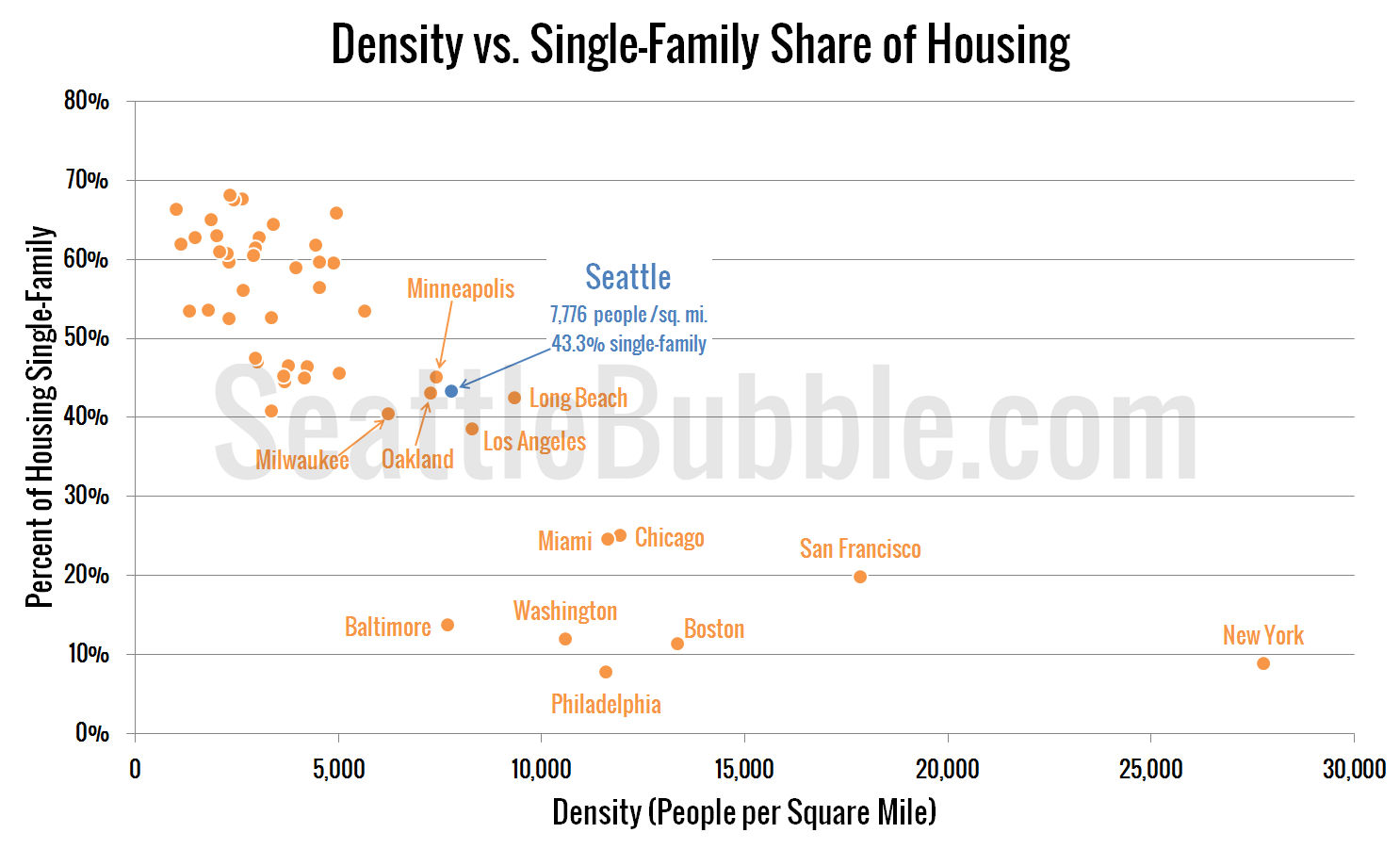
And here’s the same list of cities, sorted by population density (people per square mile):

Top 25 US Cities by Population

Now here’s the same list of cities, sorted by median list price (source):

Top 25 US Cities by Population, Sorted by Median List Price

Detroit at #25 makes sense to me. Seattle at #3 above New York, Los Angeles, Boston, and Chicago… not so much. I guess Seattle is still special (at least in the minds of sellers)!

→ 72 CommentsCategories: Statistics
Tags: , , , , ,

Local Housing Oversupply Could Disappear by July 2010…

By The Tim on March 19th, 2009 at 12:57 PM · 39 Comments

Good news everyone!

The latest population estimates for King County have been released by the Census Bureau, and at the present rate of population growth, we’ll be able to use up all of our excess housing inventory by July of next year…

if all residential construction across the county completely ceased after July 2008, that is.

Here’s an updated look at our supply and demand situation, indexed to 2000.

King County Housing Supply & Demand

Unfortunately, supply data for 2008 will not be released until August, and in reality construction of new housing units did not come to a complete stop after July 2008, so we will undoubtedly still be sitting on a housing oversupply.

What amazes me is that even in the current economic and lending environment, I am still seeing plenty of in-progress new construction, even including batches of those nasty compact townhomes that have become such a blight on some Seattle neighborhoods.

Running some quick numbers, if the population growth rate holds steady, and the construction of new housing units drops by 25% of the 2000-2007 average, it will take until 2017 before we work through the oversupply.

If new construction drops by 50%, we absorb the oversupply by 2012.

If new construction drops by 75%, we absorb the oversupply by 2010.

Keep in mind, that these figures merely state how long it will take us to get back to roughly the same overall housing vacancy rate we had in 2000, which was by most measures a relatively balanced market. Once we work through this oversupply, it is not likely that double-digit appreciation is going to spring back up out of nowhere, unless new construction has completely halted and stays that way for year after year.

So the big question is, how much has new construction really dropped by in the Seattle area? Are we looking at two years of an oversupplied housing market, or eight?

→ 39 CommentsCategories: Statistics
Tags: , , ,

Housing Shortage or Overbuilt—A New Look at Supply and Demand

By The Tim on November 5th, 2008 at 10:28 AM · 57 Comments

There has been some talk lately about the overall housing stock in the Seattle area, and whether construction has been able to keep up with population growth, or if there is a housing shortage that will lead to another housing boom in a few years. So I thought now would be a good time to revisit an old post from October 2006—Big Picture: Supply vs. Demand.

For the charts below I have taken data on the number of households and the number of housing units from the annual American Community Survey results from 2000 through 2007.

Here’s what the housing supply and demand picture looks like for King, Snohomish, and Pierce counties combined, indexed to 100 in 2000.

Puget Sound Housing Supply and Demand
Click to enlarge

Puget Sound housing supply increased 12.1% from 2000 to 2007, while the number of households increased only 7.6%. In terms of raw numbers, population increased by 92,911 households during that time, while 151,710 housing units were added, resulting in an oversupply of 58,799 housing units for the 7-year period. In other words, from 2000 through 2007, 1.6 new housing units were constructed for every new household.

Here’s the same data as above, broken down by county:

Puget Sound Housing Supply and Demand by County
Click to enlarge

Surprisingly, the overbuilding was most dramatic in King County, where 74,608 housing units were added for a mere 35,905 households, providing 2.1 new housing units for every new household. Snohomish and Pierce were roughly the same as each other, coming in at 1.4 and 1.3 new housing units per new household, respectively.

Here’s a slightly different take on the data, showing the percent occupancy rate from 2000 through 2007 for each of the three counties.

Puget Sound Housing Occupancy by County
Click to enlarge

Occupancy has been steadily declining this decade in all three counties, with 2007 setting a low point in King County that has not been matched since the 1970 Census.

So please, tell me again how there’s a housing shortage in the Seattle area. I enjoy fairy tales.

→ 57 CommentsCategories: Statistics
Tags: , , ,

Big Picture: Supply vs. Demand

By The Tim on October 25th, 2006 at 12:08 PM · 50 Comments

Why have residential real estate prices experienced an unusually rapid increase in last few years? That’s the big question that we all want the answer to, right? There’s one argument that goes something like this:

There just aren’t enough homes for everyone. People are moving to the Puget Sound at a rapid pace, and homebuilding just isn’t keeping up. Furthermore, even as more people move here, the size of households keeps shrinking, meaning that demand is increasing even faster! So it makes good sense for home prices to soar and rents to increase, because people have far less choices about where they will live than they did ten or twenty years ago.

Indeed, this would be a pretty compelling argument, if it were backed up by the facts… but is it? I dug through the Census archives to find the answer.

As it turns out, most elements of the above argument are true. Population is indeed rising at a fairly rapid pace. From 1960 to 2000, King County population surged from 935,014 to 1,737,034—an increase of 86%. During that same time period, the average household size dropped 21%, from 3.04 to 2.39. These two statistics combine to give us a 136% net increase in the total demand as measured by the number of households (307,759 to 726,792).

On the supply side of the equation, the number of “housing units” also experienced a greater than two-fold increase (122%), from 333,959 in 1960 to 742,237 in 2000. Of course, 122% is not as large of an increase as 136%, so you can see that from 1960 to 2000, home building did not in fact keep up with demand. This caused the percentage of occupied housing in King County to steadily increase from 92.15% in 1960 to 97.92% in 2000.

This is all very interesting, and so far would appear to back up the “not enough housing” argument. Of course, it is said that the best lies are those that contain the most truth. The real boom in King County home prices didn’t start until after the year 2000. So let’s compare 2000 to 2005*, using numbers readily available directly from the Census website.

In 2000, there were 742,237 housing units available to 726,792 households, for an occupancy rate of 97.92%. In 2005, there were 792,682 housing units available to 747,157 households, dropping the occupancy rate to 94.26%, a level not seen since 1980. Whoa. It would appear that during the five years of most aggressive home price growth, home building has more than kept up with increased demand.

Here is the complete data table for 1960 to 2005:

Year Population Households Hshld Size Hsng Units % Occ.
1960 935,014 307,759 3.04 333,959 92.15%
1970 1,159,369 391,759 2.96 424,837 92.21%
1980 1,269,898 497,263 2.55 525,562 94.62%
1990 1,507,305 628,044 2.40 647,339 97.02%
2000 1,737,034 726,792 2.39 742,237 97.92%
2005* 1,755,818 747,157 2.35 792,682 94.26%

It should be noted that there are many different sources available for current (2005) population estimates. However, even under the most aggressive of these estimates, the occupancy percentage still declines from 2000 to 2005 (down to at least 1990 levels). I chose to use the data on the Census website since it was most directly comparable to previous Census data, and it is the only source I have been able to locate that contains an estimate of the average household size and number of housing units for 2005.

So what does this all mean? I think at the very least it shows that home building in King County has kept up with demand during the recent housing boom. It seems most likely that building has even surpassed demand by a non-trivial amount. If you have data that shows otherwise, I would love to see it. However, after considering the available data, I believe we can safely bury yet another unfounded argument that attempts to justify today’s housing prices.

*2005 data based on the 2005 American Community Survey, which “is limited to the household population and excludes the population living in institutions, college dormitories, and other group quarters.” Therefore, while total population is likely to appear low when compared directly to Census data, the number of housing units is also scaled down accordingly. Since this post is about housing supply for “households,” the exclusion of group quarters does not affect the final “percent occupancy” calculations.

(US Census Bureau, 2000, 2005)

→ 50 CommentsCategories: Statistics
Tags: , , ,