Seattle Bubble

News & discussion about real estate & the housing bubble in the Seattle area.

Seattle Bubble - News & discussion about real estate & the housing bubble in the Seattle area.

Entries Tagged as 'price-to-income'

Housing Stats: Seattle vs. Other Big Cities

By The Tim on September 24th, 2009 at 10:16 AM · 22 Comments

Building on the data that was presented yesterday, here’s a sortable table of some more detailed housing stats for the 25 largest US cities by population. Included below are population, density, median sale price, median price per square foot, median rent, median household income, median list price, and some ratios of sale prices to rents and incomes. Unfortunately sale prices are not available in Texas or Indiana (which is why I went with list price in yesterday’s post).

Click on any column header to sort by that column. Enjoy!

City State Pop. Density Med. Sale Med. $/sqft Med. Rent Med. HH Inc. Sale/Rent $/Sqft/Rent Sale/Inc. Med. List
New York NY 8,363,710 27,440 $471,200 $339 $985 $48,631 39.9 0.34 9.7 $449,900
Los Angeles CA 3,833,995 8,205 $442,800 $293 $986 $47,781 37.4 0.30 9.3 $447,000
Chicago IL 2,853,114 12,649 $255,500 $199 $832 $45,505 25.6 0.24 5.6 $276,000
Houston TX 2,242,193 3,828 $749 $40,856 $187,000
Phoenix AZ 1,567,924 2,938 $158,600 $96 $797 $48,061 16.6 0.12 3.3 $160,000
Philadelphia PA 1,447,395 10,721 $150,600 $122 $770 $35,365 16.3 0.16 4.3 $169,000
San Antonio TX 1,351,305 2,809 $698 $41,593 $159,900
Dallas TX 1,279,910 1,427 $737 $40,986 $215,000
San Diego CA 1,279,329 1,612 $394,800 $284 $1,209 $61,863 27.2 0.23 6.4 $427,000
San Jose CA 948,279 2,223 $486,800 $322 $1,249 $76,963 32.5 0.26 6.3 $499,000
Detroit MI 912,062 6,378 $51,600 $37 $704 $28,097 6.1 0.05 1.8 $16,500
San Francisco CA 808,976 17,323 $728,200 $579 $1,192 $68,023 50.9 0.49 10.7 $800,000
Jacksonville FL 807,815 1,062 $155,600 $95 $831 $48,699 15.6 0.11 3.2 $160,000
Indianapolis IN 798,382 2,152 $668 $44,325 $112,500
Austin TX 757,688 2,396 $829 $48,966 $253,000
Columbus OH 754,885 3,556 $137,300 $93 $703 $42,253 16.3 0.13 3.2 $129,900
Fort Worth TX 703,073 1,828 $753 $47,104 $155,000
Charlotte NC 687,456 2,516 $174,800 $101 $786 $52,690 18.5 0.13 3.3 $189,900
Memphis TN 669,651 2,327 $124,200 $72 $719 $35,143 14.4 0.10 3.5 $103,500
Baltimore MD 636,919 7,889 $169,300 $137 $778 $36,949 18.1 0.18 4.6 $149,900
El Paso TX 613,190 2,447 $564 $35,646 $149,900
Boston MA 609,023 12,561 $356,100 $365 $1,107 $50,476 26.8 0.33 7.1 $389,000
Milwaukee WI 604,477 6,296 $138,100 $118 $689 $35,281 16.7 0.17 3.9 $129,900
Denver CO 598,707 3,905 $229,500 $169 $726 $44,444 26.3 0.23 5.2 $275,000
Seattle WA 598,541 7,179 $386,500 $283 $881 $57,849 36.6 0.32 6.7 $450,000

→ 22 CommentsCategories: Statistics
Tags: , , , , , ,

Improvement in Seattle Home Prices vs. Economic Fundamentals

By The Tim on August 14th, 2009 at 7:21 AM · 57 Comments

Here’s an update to the area-wide price-to-income and price-to-rent ratio charts we first posted back in April.

These charts are based on per capita income, “Median Contract Rent” (from 2005 adjusted using the “rent of primary residence” component of the CPI), and Case-Shiller home prices indexed to the county-wide median. They are not intended to be used as a valuation tool for any specific home or neighborhood, but rather as a broad measure of the local housing market as a whole.

First up, the home price to income ratio:

Seattle-Area Home Price to Income Ratio

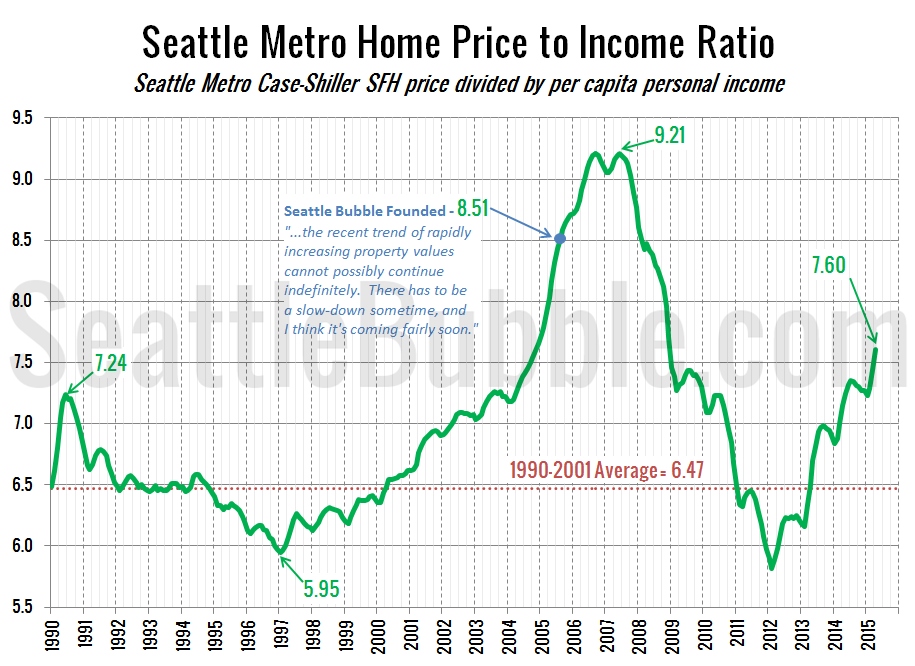
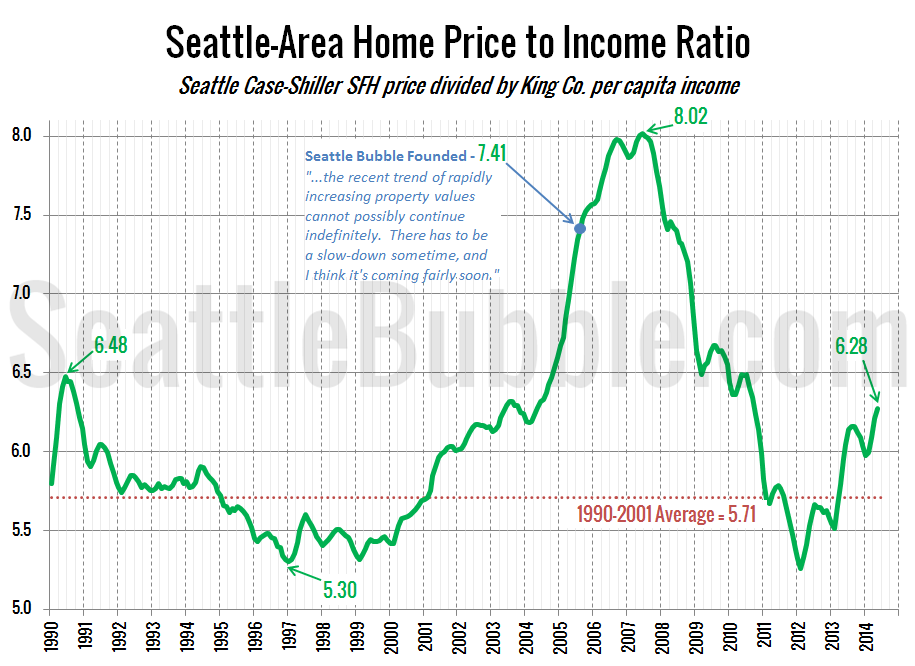
There has been a little bit of improvement since our last update, with the ratio falling another 0.19 points (3%). As of May (the latest Case-Shiller data presently available) the price to income ratio sits roughly 5% above the 1990-2001 average (an improvement from 8% in January).

Here’s the home price to rent ratio:

Seattle-Area Home Price to Rent Ratio

Improvement on that front as well, with the ratio dropping 12.7 points (3%) since the April update. The price to rent ratio is still 19% above its 1990-2001 average (an improvement from 23% in January).

Since incomes and rents are currently falling along with prices, neither ratio has improved as much as we might expect. In the five months between January and May this year, Seattle-area home prices fell 3.5%, but since income also fell 0.6% and rents dropped slightly as well (0.3%), neither ratio has fallen quite as much as the raw drop in home prices.

The mini-plateaus over the last few months in both of the above charts closely resemble the same spring “bounce” that was seen last year. Following last year’s spring plateau from May to December, the price to rent ratio fell 14%, while the the price to income ratio fell 11%. It will be interesting to see where each ratio sits at the end of this year.

→ 57 CommentsCategories: Statistics
Tags: , , , , ,

What does Personal Income tell us about near future home prices?

By deejayoh on June 1st, 2009 at 9:00 AM · 72 Comments

There have been a couple of discussions in the comments section in the last week or so about the relationship between home prices and incomes.   I thought it would be  a good time to queue up a post about the long-term price-to-income trends, where we are now, and what the possible outcomes could be.

The analysis in this post are all based on annual data for King County for the period from 1969-2008 – a period that covers five recessions.  For home prices, I used the King County MLS median price for SFH, pulled from The Tim’s long-run home price chart.  Tim’s data in this series shows home values in April and October of each year.  I used the October data.  For income, I pulled the data for King County Personal income per capita (PCI) from www.bea.gov.  This time series runs from 1969-2007.  In order to estimate PCI for 2008, I grossed up the 2007 figure by 1%, which was the estimate of Median HHI income growth for King County by the Washington Office of Financial Management (OFM).

[Note from The Tim: For a more granular look at the short-term price-to-income trend since 1990, hit this post.]

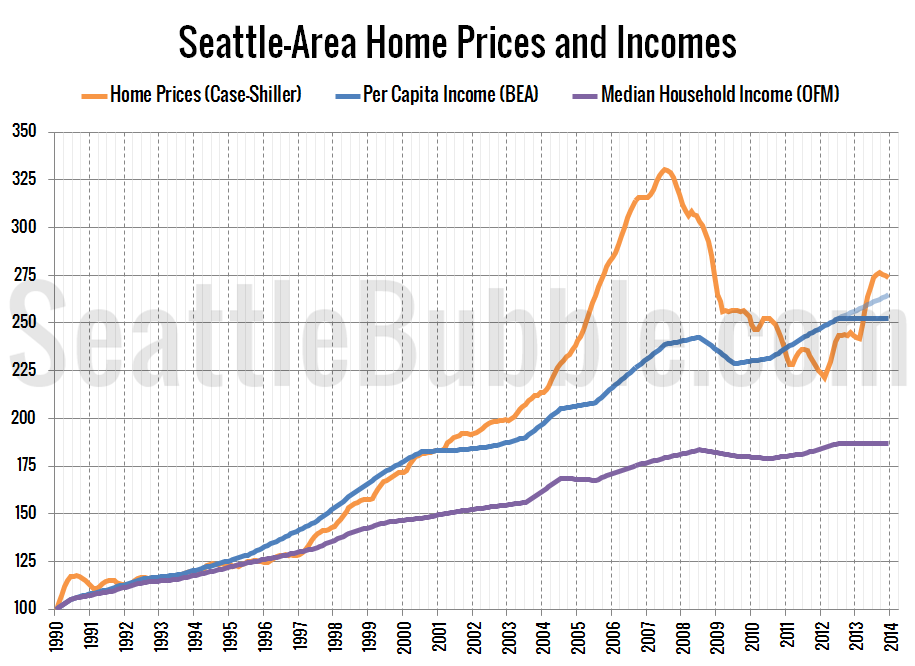
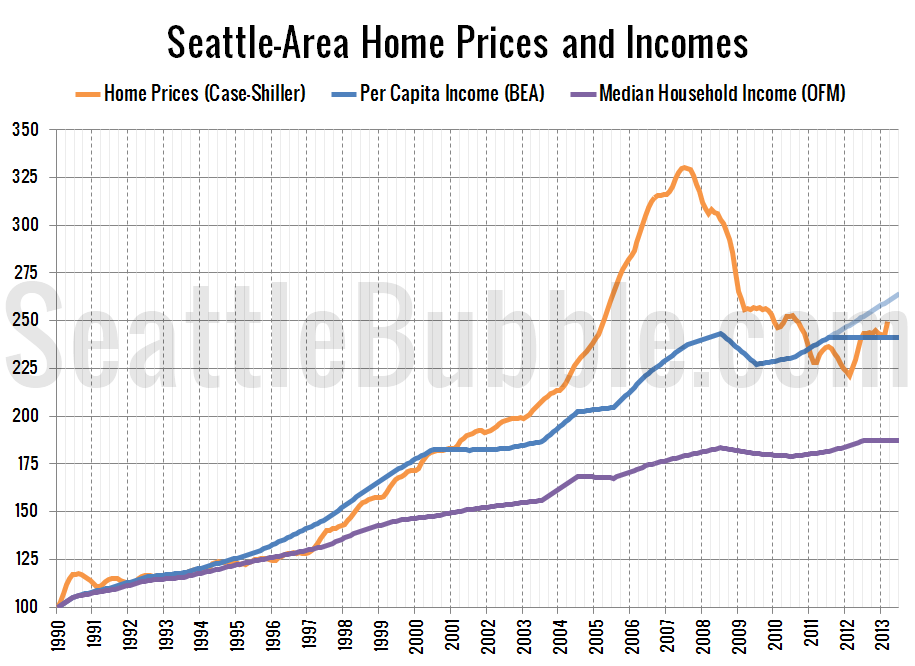
The first analysis is a simple line chart showing the historical ratio of home prices to income.   Here we can see that, up until the turn of the century, home prices bounced around in a fairly narrow range when expressed as a multiple of incomes.  The multiple is closer to 4x in times of economic duress (e.g. the oil crisis and mid-eighties recession) and rises up closer to 6x in better times.  But the average multiple of home prices to incomes between 1969 and 2000 was almost exactly 5x.  Then, as lending rules are eased in 2001 -  we see the multiple grow steadily until it peaks over 8x in 2006, before falling back to 7.1x as of October 2008.

King County, 1969-2008

Based on this chart it is pretty clear to me that claims that home prices falling to their “normal state” of 3x income are best discussed on Snopes.com.  There is no historical precedent for the median price for homes in the Seattle area being that low relative to income in most of our lifetimes – and even if it has fallen to that level at some point in the past, I doubt home prices have averaged 3x income for any extended period of time.  Based on the last ~40 years the “bottom” for home prices based on the income multiple appears to be about 4x incomes.

The second analysis uses the same data, but presents the results as a scatterplot.  Here we can see even more clearly the impact of the changes in lending standards in 2001.   From 1969 to 2000, the relationship between home prices and incomes (shown in blue) follows an almost linear path.  The r-square between these two time series is over 97%.  Using a “best fit” line shows that the best predictor for home prices as a multiple of incomes during this time period is 5.35x – slightly higher than the mathematical average from the analysis above – but probably a slightly better estimate of the long run trended value.

Home prices vs. Income Growth

The red points clearly show home prices diverging from the long-run trend line in 2001, and moving back toward it beginning in 2007.  I think this is the starkest evidence I have seen showing how the “fundamentals” of income as a driver of home values disappeared in the boom.  After tracking income for 30+ years, home prices set off on their own path just as new financing vehicles and standards were introduced to the market.

This chart also casts doubt on that the claim that the boom “started late” in Seattle.  You can clearly see that home prices were shooting up relative to incomes in 2001 and 2002, before leveling off slightly in 2003.  The perception that we were not “booming” was probably due to  income growth being depressed by the end of the dot com boom and the stock market crash – but the ratio of home prices to incomes was steadily increasing.

I also ran an analysis comparing the annual change in home prices to the annual change in incomes.  This is a “purer” analysis because with two trended series (e.g. home prices and incomes) a large portion of the explanatory value is the result of autocorrelation.  I haven’t clipped the graph in here, but the r-square for this analysis was 0.3 – which is pretty high for a single variable regression using two fairly noisy series.  It was enough to satisfy my curiosity, as I am entirely comfortable with the premise the primary driver of  home prices is income levels, all other things being equal (e.g. financing terms, relative supply)

Based on this comparison, my observations are as follows:

  • This is evidence to me that we are clearly still far from the bottom.  Depending on your viewpoint, prices should fall back at least to the long-run income multiple (I’ll use 5.35x) and could drop as low as 4x.  Based on this data series, I see no precedent for a lower multiple.
  • King County PCI for 2008 should be about $55k, and given the state of the economy it will probably stay about the same in  2009 .  Applying those income multiples would indicate the King County median would  “bottom”  somewhere between $220k and $295k.
  • The April median for King County SFH was $380k, indicating a possibility of 22-42% of additional downside risk

For home prices to fall much further than this (e.g. the super-bear’s $100k prediction), it seems to me that one or more of the following things would have to be true:

  1. Home price/income multiples would have to diverge greatly from 30+ years of historical precedence
  2. Incomes would have to fall dramatically
  3. Lending standards would have to be tightened dramatically from their pre-bubble standards.  (A simple increase in rates should not be a unique condition, as the period of this analysis includes the double digit rates in the early ’80s)
  4. Some other extraordinary event would have to take place such as a change in the tax treatment of real estate.

Note that I am not saying any of these things won’t happen. But it does seem to me that conditions would have to change quite dramatically to result in that extreme of a drop in values.  As of today, it appears incomes are relatively stable, lending standards have (for the most part) returned to pre-bubble conditions, and home prices are trending back to the long run income multiple.

My caveat: This analysis is not intended to be predictive.  It is intended as additional information from which you, the reader can generate your own opinions about where the housing market is going and make an informed decision on a housing purchase during a period of great uncertainty.  Hopefully it will generate good discussion in the comments section.

→ 72 CommentsCategories: Features · Statistics
Tags: , , , ,

Seattle Homes Still 10-20% Overpriced Compared to Rents and Incomes

By The Tim on April 2nd, 2009 at 11:11 AM · 83 Comments

Inspired by this post from Rich Toscano down in San Diego showing that home prices there have reached historically reasonable levels when compared to rents and incomes, I thought I would put together some similar charts for Seattle to see how close we are to reasonable home prices.

Here’s the chart for home prices to per capita incomes, from January 1990 (as far as Seattle’s Case-Shiller data goes back) through January 2009:

Seattle-Area Home Price to Income Ratio

As of January, Seattle’s home price to income ratio is at levels last seen in May 2002. Not bad, but still about 8% higher than the 1990-2001 average, and 16% higher than where the ratio bottomed out during the bust that followed the early ’90s housing boom.

And here’s the chart for home prices to rents:

Seattle-Area Home Price to Rent Ratio

The home price to rent comparison has “rewound” to approximately October 2003, and is overall less in balance from a historical perspective than the price-to-income ratio. January 2009’s value came in 23% higher than the 1990-2001 average, 34% higher than the previous bottom, and even 17% higher than the June 1990 peak value.

[Update: I should add that the specific area-wide rent ratio values are somewhat arbitrary, and are only really useful to compare to their own past performance. I strongly recommend against using them as a valuation tool for any specific home or neighborhood.]

It’s worth pointing out that both rents and incomes in the Seattle area are currently on downward trends of their own, which will only serve to prolong the inevitable correction to historically sustainable ratios.

The good news is that at the present rate of correction, Seattle-area home prices will likely hit the “reasonable” range compared to local incomes and rents sometime late this year to early next year. Note that home prices will likely continue to fall even after we hit that range, (as they are currently in San Diego), but that would at least indicate that homes are no longer overpriced with respect to historical fundamentals.

→ 83 CommentsCategories: Statistics
Tags: , , , , ,