Seattle Bubble

News & discussion about real estate & the housing bubble in the Seattle area.

Seattle Bubble - News & discussion about real estate & the housing bubble in the Seattle area.

Entries Tagged as 'affordability'

Affordability Declined in Q3 as Housing Market Heated Up

By The Tim on October 30th, 2009 at 6:00 AM · 3 Comments

The latest issue of Sound Housing Quarterly has been published. Sound Housing Quarterly is a subscription-based sister project to Seattle Bubble. Here are a couple of highlights from the third quarter issue.

The Real Estate Heat Index (a proprietary index I created that uses supply, demand, and home prices to calculate the general “heat” of the housing market) rose in all seven Puget Sound Counties in the third quarter, but still remains below pre-bubble levels.

Real Estate Heat Index: King, Snohomish, Pierce

Meanwhile, affordability dropped in every county but Snohomish, despite interest rates in the 5s.

Affordability Index: King, Snohomish, Pierce

The full version of Sound Housing Quarterly includes detailed data and analysis for King, Snohomish, Pierce, Kitsap, Thurston, Island, and Skagit counties.

Head over to HousingQuarterly.com to subscribe to Sound Housing Quarterly. You can also download a free single-page summary of this quarter’s report, or head over to the free archive to check out last year’s Q3 report in full.

→ 3 CommentsCategories: Features
Tags: , ,

Reader Question: No Debt & An Impending Raise – Time to Jump In?

By The Tim on October 19th, 2009 at 11:00 AM · 74 Comments

Here’s a question I received from a reader over the weekend:

I have $50k in the bank, no debt, make 50k per year and am confident in a position that will pay 75k per year starting 06/10. Let’s assume that if the position doesn’t happen, I will take a second job to make up the difference.

I’ve never owned a home. Rent for me is one room in a house and just $400/mo. A place I buy would need to be on the eastside.

I’ve lived well below my means for years (and also been a Seattle Bubble reader for that amount of time). But in my current situation I’m seriously considering a first home. Your opinion on my situation would be appreciated.

- “Seattle Bill”

Here’s my advice for Bill:

1) Structure your budget around what you already have today, not what you might have sometime in the near future.

You’re making $50,000 today. That’s what you have to work with, not $75,000. If you buy today, setting your budget based on a future expectation of a massive increase in salary, you’re setting yourself up for failure.

Here’s what I recommend to anyone that is considering buying, in any market. First, go to your preferred mortgage broker, bank, or credit union and find out what kind of loans you are qualified for, how much you can borrow, and what your monthly payment would be. Getting a pre-qualification does not require you to commit to a lender or a loan, but will tell you for sure how much you can borrow.

For example, let’s say you were pre-qualified for a $250,000 loan, with a monthly principal + interest payment of $1,100. Add in probable taxes and insurance (we’ll say another $350 / month), and you’ve got a total monthly PITI obligation of $1,450. With a yearly salary of $50,000, that comes out to 34% of your gross income.

Here’s a simple affordability calculator I posted earlier this year to help you quickly calculate your own personal affordability situation.

Personally, my absolute upper limit would be 30%, but even that would come out to $1,250 a month for you, which is over three times what you’re paying right now. Figure out what you think you’d be comfortable with, and then force yourself to live with that budget for six months, saving the difference between your current rent and your expected monthly house payment.

If you succeed in living within that budget for six months, you’ll have a pretty good idea of what other sacrifices you’ll have to make to buy the house, and you’ll have another $5,000+ in the bank to help pay for closing costs or your down payment. If your salary does end up rising by 50%, either stick to what you could afford with $50k, or get pre-qualified again with the new salary, and “test drive” your budget again with the new salary.

2) If you decide to buy, pay a price that you think is fair for the house today (assume that it may stagnate or decrease in value in the future).

One surefire way to set yourself up for financial problems in the future is to rationalize your decision to buy a house by convincing yourself that it is a great financial investment.

There are plenty of great reasons to buy a house. Buy a house because you want a place that you have control over. Buy a house because you want stability. Buy a house because you want to plant a garden. Buy a house because you want to breed Irish Wolfhounds. Just don’t buy a house because you think it will make you money. Maybe it will, maybe it won’t, but that factor should not be a part of your decision-making process.

3) Keep your eye on bank-owned houses, and look for homes that need a little work.

There are definitely some good deals to be found out there today, but they’re not in the owner-occupied homes that have been “upgraded” with hardwood floors, granite countertops, and a fresh coat of paint on the outside. High curb appeal may sell a house fast, but it doesn’t sell a house at a good bargain. If you’re willing to put in a little bit of work, look for bank-owned fixers.

The Bottom Line: Know what you’re getting into.

Nobody can tell you what you should do, since no two people have the same financial situation. My recommendation is just that you do the research, critically evaluate your finances, and should you decide to buy, do so with realistic expectations.

So what’s your advice for Seattle Bill? Let’s hear from the commenters.

→ 74 CommentsCategories: Features
Tags: ,

Comment of the Week: Impulsive Behavior Disorder

By The Tim on August 28th, 2009 at 7:14 AM · 198 Comments

This comment of the week is brought to you by Jonness:

All’s I know is my household income is 6 figures, I have no kids, I have 20% down, and I still don’t feel like I can afford a house priced $400K. How people are pulling the FHA trigger with 3.5% down and $70K in household income is beyond me. I mean, what happens if a spouse loses a job or a family member gets ill? Don’t people care about long-term stability in their lives? It appears to me, a lot of people borrow as much as they possibly can at every new moment in time.

IMO, no houses are affordable right now, because buyers like me have to compete with 10 flaky families overstretching themselves to get a dump on a 6K sq. ft. lot. They do this purely out of ignorance and an inability to control their impulsive behavior disorder. Then when they default, I pay taxes to bail their irresponsible arses out. Meanwhile, the govt. floods the market with borrowed dollars in order to artificially inflate the price of the foreclosed home so that the crazy banker who made the outrageously risky loan can continue to live in a house that I cannot afford to buy.

This game is crazy.

So what’s the cure for impulsive behavior disorder? Is there one? Surely there must be a way out of this self-destructive cycle, right?

→ 198 CommentsCategories: Features
Tags: , , ,

What the Heck is the Affordability Index, Anyway?

By The Tim on August 27th, 2009 at 6:00 AM · 23 Comments

Seattle Times business reporter Eric Pryne quoted me yesterday in his article about the affordability index, and as I was reading through the comments posted at the Seattle Times website, I noticed an awful lot of misconceptions about what the affordability index is, and what it tells us. So, I thought maybe it would be a good time for a bit of an in-depth course on the concepts behind the affordability index.

Any time you attempt to simplify a complex concept into a single number, it is important to recognize the assumptions that go into calculating that number. Whether we are discussing the affordability index, the Case-Shiller home price index, or even the UV index, full understanding is crucial to a constructive conversation.

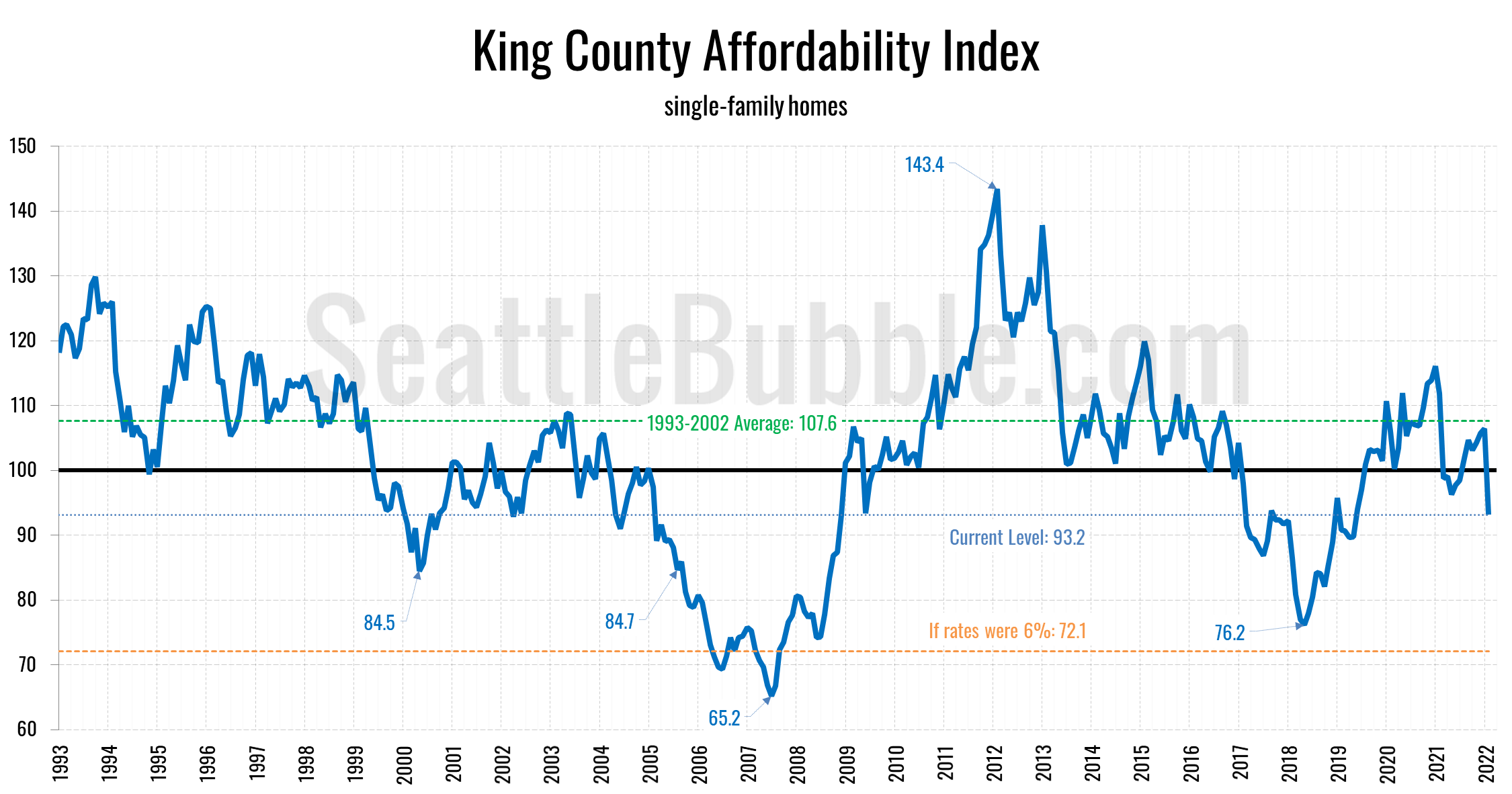
To kick things off, here’s King County’s quarterly affordability index back through 1993, the furthest back NWMLS median home price data is available, so we can all get a visual of the data that we’re discussing.

King County Affordability Index

What the Affordability Index Is

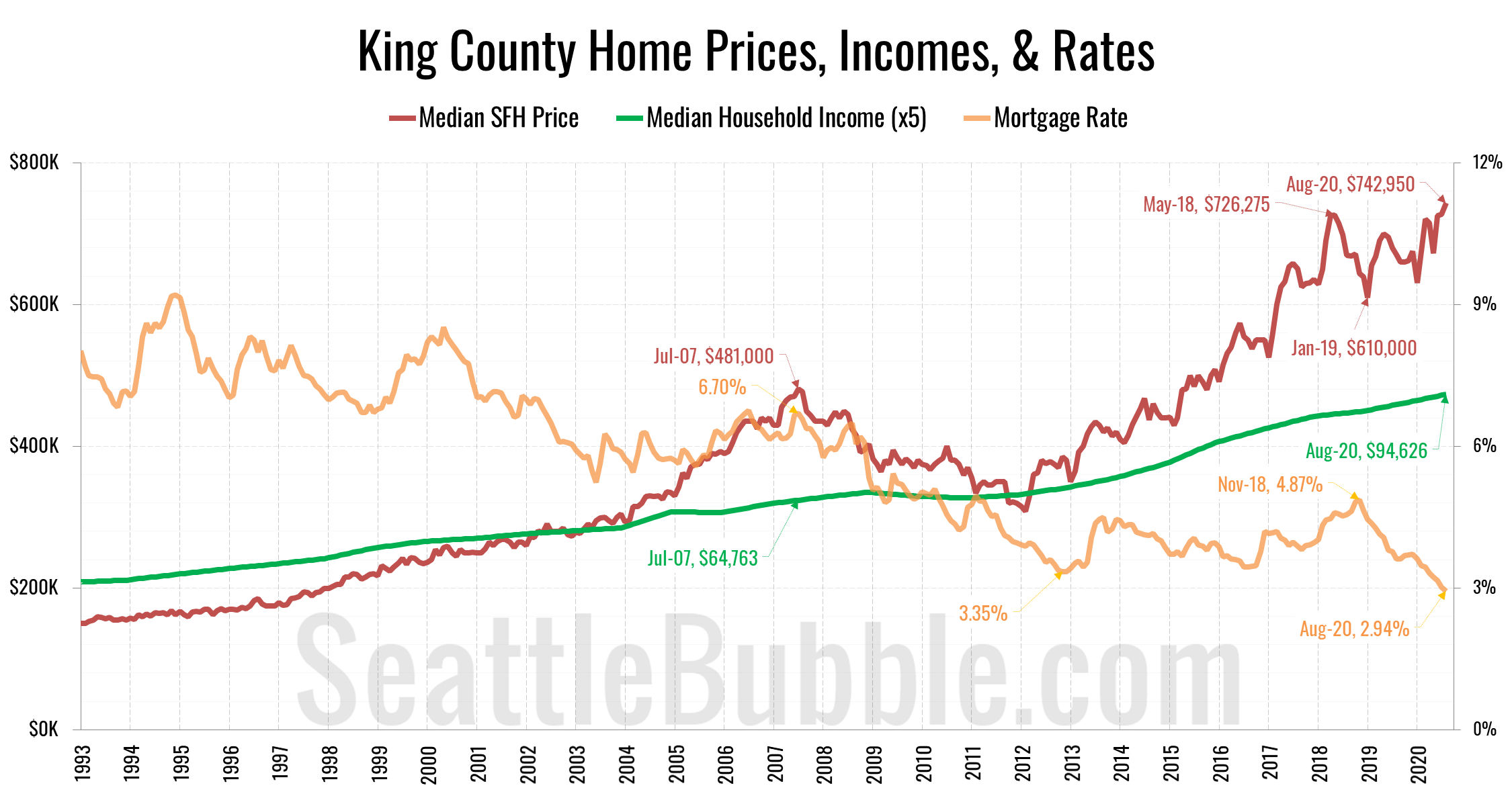
In short, the affordability index is a simple measure that shows the relationship between median home prices, median household incomes, and interest rates. It is useful merely as one tool of many in gauging the overall health of a given housing market.

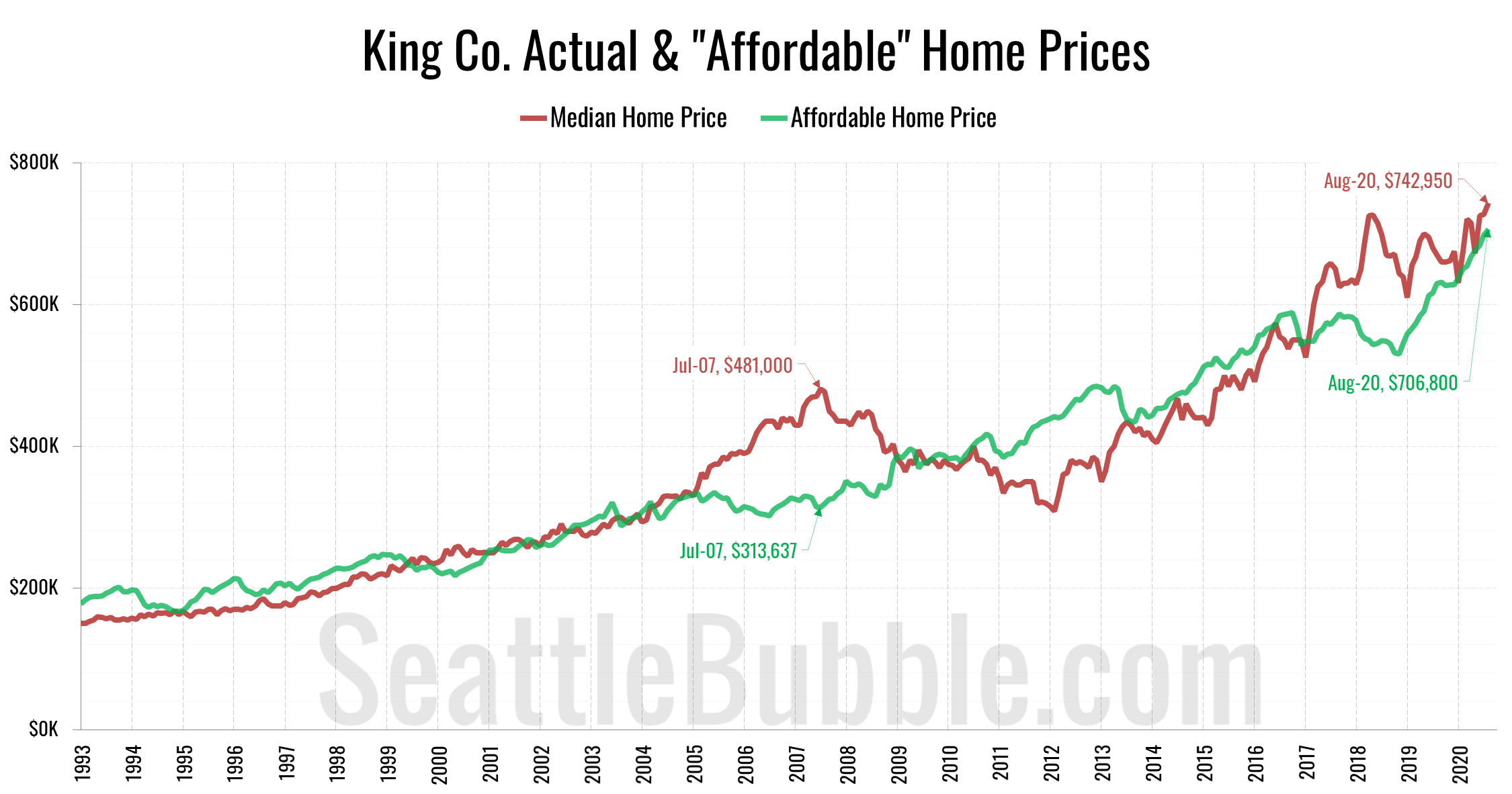
It is calculated by determining the monthly payment (principal and interest) that would result from buying the median-priced home, assuming a 20% down payment and current interest rates on a 30-year fixed-rate mortgage, then comparing that to 30%* of the monthly median household income (the standard measure of “affordable housing”). Note that the median household income is merely the mid-point taken from a sample of all households in the county, whether they are one person households or ten person households.

An affordability index of 100 means that a hypothetical household earning the median household income would pay exactly 30% of their monthly income toward the principal and interest of a mortgage on the median-priced house if they bought today with 20% down using a 30-year mortgage at prevailing interest rates. Above 100 is more affordable, while below 100 is less affordable.

What the Affordability Index Is Not

The affordability index is not intended to tell you whether or not you can afford a specific house in your specific financial situation. It is not a tool for determining the value of a specific house. It should not be used as a sole signal of when it is or is not a “good time to buy.”

Interest rates are used in calculating the affordability index, but the availability of financing is not a factor in the calculation. There is no easy way to quantify the fact that in 2005 anyone who could “fog a mirror” could waltz into a $400,000 loan, while today the standards are much stricter.

The historic standard for “affordable housing” is that a household not spend more than 30% of their gross income on total housing expenses. Note that when we calculate the affordability index we are only taking into account the principal and interest payment on the mortgage. The affordability index does not include the expense of taxes, insurance, maintenance, or any sort of home owners’ association dues.

It is also important to note that with respect to down payments, the affordability index simply assumes 20% down, and leaves it at that. Obviously very few people have 20% of the median home price saved up in cash sitting in a bank account to be used as a down payment. With the median single-family home priced at $384,000 in King County as of July, that would be $76,800. I would not be surprised if the majority of families do not even have one tenth that amount saved. However, you have to assume something, and if you assume less than 20% the equation would become much more complicated with PMI or piggy-back loans.

The affordability index also does not take into account an area’s jobless rate. An affordability index of 100 does not mean that a majority of households can now afford to buy a house, because it does not factor in unemployment, savings, or credit scores.

Conclusion

Some of the commenters on the Seattle Times article seemed to be extremely frustrated, decrying the article as “lies and inflated information,” or “propaganda.” This is somewhat understandable given the claim in the headline that the Typical King County family can again afford median-priced house (although I doubt Eric was the one that wrote that headline). However, the article itself stuck to the facts: King County’s affordability index has indeed recovered in recent months, thanks to a combination of falling home prices and falling interest rates.

Most of the anger in the comment section seemed to stem from a misunderstanding of what the affordability index actually is. Unfortunately, one of the downsides of the newspaper format is that they are not usually able to delve into a subject like this in depth to the degree that would be necessary to fully explain the underlying concepts to every reader. Hopefully this post is able to fill that hole for some of the confused and upset readers out there.

Additional Resources

Data Sources

*The Seattle Times article says that the WCRER uses 25% of income in their calculations, but I have always used 30% as it is the more standard measure of “affordable” and my calculations tend to match pretty closely to theirs.

→ 23 CommentsCategories: Statistics
Tags: , , , , , ,

Improvement in Seattle Home Prices vs. Economic Fundamentals

By The Tim on August 14th, 2009 at 7:21 AM · 57 Comments

Here’s an update to the area-wide price-to-income and price-to-rent ratio charts we first posted back in April.

These charts are based on per capita income, “Median Contract Rent” (from 2005 adjusted using the “rent of primary residence” component of the CPI), and Case-Shiller home prices indexed to the county-wide median. They are not intended to be used as a valuation tool for any specific home or neighborhood, but rather as a broad measure of the local housing market as a whole.

First up, the home price to income ratio:

Seattle-Area Home Price to Income Ratio

There has been a little bit of improvement since our last update, with the ratio falling another 0.19 points (3%). As of May (the latest Case-Shiller data presently available) the price to income ratio sits roughly 5% above the 1990-2001 average (an improvement from 8% in January).

Here’s the home price to rent ratio:

Seattle-Area Home Price to Rent Ratio

Improvement on that front as well, with the ratio dropping 12.7 points (3%) since the April update. The price to rent ratio is still 19% above its 1990-2001 average (an improvement from 23% in January).

Since incomes and rents are currently falling along with prices, neither ratio has improved as much as we might expect. In the five months between January and May this year, Seattle-area home prices fell 3.5%, but since income also fell 0.6% and rents dropped slightly as well (0.3%), neither ratio has fallen quite as much as the raw drop in home prices.

The mini-plateaus over the last few months in both of the above charts closely resemble the same spring “bounce” that was seen last year. Following last year’s spring plateau from May to December, the price to rent ratio fell 14%, while the the price to income ratio fell 11%. It will be interesting to see where each ratio sits at the end of this year.

→ 57 CommentsCategories: Statistics
Tags: , , , , ,

King County Home Prices & Affordability 1950-2009 Q1

By The Tim on May 20th, 2009 at 5:00 AM · 85 Comments

A reader pointed out that I had not provided an updated chart of the long-term (50+ year) trend of local home prices since I originally posted my research in February 2008. So, here’s an updated look at the long-term trends in local home prices and affordability:

King County Median Home Prices: 1946-2009

So much for Steve Tytler’s famous “stair step” theory (which he was still espousing as recently as July 2008).

Note that in the above chart, each data point represents a 6-month average, and in the chart below, each represents a 12-month average. For 2009 we are using the 4-month average of January – April.

King County Affordability Index

I’d love to provide you with a more substantive post today, but I’m taking my birthday off (this post was pre-written last night). See you tomorrow.

Sources:
(1946-1992 Home Prices: Seattle Real Estate Research Report)
(1993-2009 Home Prices: NWMLS)
(Misc. Price Data: Seattle Times)
(Inflation Data: Bureau of Labor StatisticsConsumer Price Index)

(Household Income: US Census Bureau)
(1950-1970 Interest Rates: Financial Forecast Center)
(1971-2009 Interest Rates: Federal Reserve)

→ 85 CommentsCategories: Features · Statistics
Tags: , , , , , , ,