Entries Tagged as 'supply'
Posted by The Tim on November 5th, 2008 at 10:28 AM · 54 Comments
There has been some talk lately about the overall housing stock in the Seattle area, and whether construction has been able to keep up with population growth, or if there is a housing shortage that will lead to another housing boom in a few years. So I thought now would be a good time to revisit an old post from October 2006—Big Picture: Supply vs. Demand.
For the charts below I have taken data on the number of households and the number of housing units from the annual American Community Survey results from 2000 through 2007.
Here’s what the housing supply and demand picture looks like for King, Snohomish, and Pierce counties combined, indexed to 100 in 2000.

Click to enlarge
Puget Sound housing supply increased 12.1% from 2000 to 2007, while the number of households increased only 7.6%. In terms of raw numbers, population increased by 92,911 households during that time, while 151,710 housing units were added, resulting in an oversupply of 58,799 housing units for the 7-year period. In other words, from 2000 through 2007, 1.6 new housing units were constructed for every new household.
Here’s the same data as above, broken down by county:

Click to enlarge
Surprisingly, the overbuilding was most dramatic in King County, where 74,608 housing units were added for a mere 35,905 households, providing 2.1 new housing units for every new household. Snohomish and Pierce were roughly the same as each other, coming in at 1.4 and 1.3 new housing units per new household, respectively.
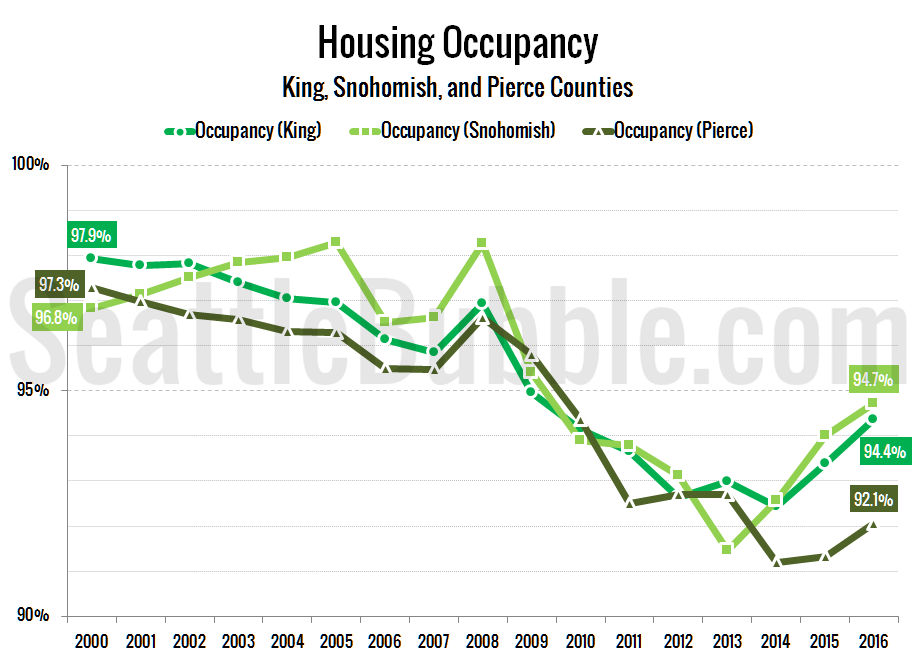
Here’s a slightly different take on the data, showing the percent occupancy rate from 2000 through 2007 for each of the three counties.

Click to enlarge
Occupancy has been steadily declining this decade in all three counties, with 2007 setting a low point in King County that has not been matched since the 1970 Census.
So please, tell me again how there’s a housing shortage in the Seattle area. I enjoy fairy tales.
Categories: Statistics
Tags: Census, demand, occupancy, supply
Posted by The Tim on September 21st, 2007 at 10:00 AM · 57 Comments
For those that continue to insist that home prices around Seattle are high because “supply isn’t keeping up with demand,” I would like to point out the 2007 King County Buildable Lands Report.
This is what the report has to say about building activity in King County from 2001 through 2005:
- King County gained more than 49,000 net new housing units in the UGA during the second five-year Buildable Lands review period (2001-2005). Accounting for assumed vacancy rates, this translates into about 47,300 net new households in Urban-designated King County, which is about 31% of the 22-year Household Growth Target added in 23% of the planning period. This growth occurred despite an economic recession and significant job loss during four of the five years of the analysis period.
- During the six years from the April 2000 US Census to April 2006, Washington State’s Office of Financial Management (OFM) estimates that King County’s population grew by 98,300 persons, from 1,737,000 to 1,835,300. This increase is nearly 32% of the 2002 OFM population projection for the planning period (2001-2022), which is the basis for the Household Growth Targets, during six years or 27% of the planning period.
- Chapter IV, p. 1
Quick calculation… 98,300 people in six years is roughly 82,000 people in five years, which translates to approximately 35,650 households (assuming an average of 2.3 persons per household—2000 Census showed 2.39). 35,650 new households (county-wide) vs. 49,000 new housing units (UGA-only). Whoops. Looks like supply has actually been easily exceeding demand, just like I said it was.
Going forward, the picture looks much the same:
- The King County UGA has capacity, based on current plans, for approximately 289,000 additional housing units accommodating an estimated 277,000 additional households—more than twice the capacity needed to accommodate the Household Growth Target of about 106,000 for the remainder of the 2000-2022 planning period.
- At projected household sizes, the 289,000 new housing units, together with the existing housing stock in 2006, could accommodate more than 400,000 additional persons within the UGA. This is more than twice the population growth needed to meet the remaining part of the 2002 OFM projection of 2,048,000 total population for King County in 2022.
- Chapter V, p. 3
Translation: the Growth Management Act and Urban Growth Boundary have not and will not result in an artificially-constrained supply of houses in King County for the foreseeable future.
Here’s a little blurb from the P-I (which is about all I expect to see, since the facts in this report don’t back up the oft-repeated “constrained supply” claim the papers love to tout):
According to the report, King County cities and towns grew slightly faster than projected from 2001 through 2005 and still had enough capacity for twice as many households as remain in the projection for growth through 2022.
In fact — thanks to rezoning, denser construction and increasing potential for redevelopment — there was more capacity at the end of the five years, despite development of 5,000 acres during that time.
Can we please stop claiming that “restricted supply” will prop up local housing prices now? I can write articles all day long about how beautiful the pretty pink sky is, but that doesn’t and won’t make it true. It just makes me annoying and ignorant.
(P-I Staff, Seattle P-I, 09.20.2007)
Categories: Uncategorized
Tags: growth_management, King_County, mythbusting, Seattle_PI, supply, urban_growth_boundary
Posted by The Tim on September 4th, 2007 at 11:55 AM · 57 Comments
A reader going by the name Angie has been making some comments on a couple of posts the last few days that merit further discussion:
…the fact is that in some places in the US all but the very rich have been priced out forever! NYC, coastal southern California, San Francisco, etc, etc. It’s been that way for a long time…but it wasn’t always that way. At some point whatever factors converge, demand forever exceeds supply, and the rest is history.
…
We’re landlocked like SF and the weather is arguably better. The local economy has diversified enough to keep the town afloat consistently. I’ve long thought that the prices here are headed into San Francisco territory–out of reach of the average Jane and Joe once and for all. Priced out forever!
…
I think housing in Seattle really is entering the realm of “permanently unaffordable” to average earners…
…
“Serious limited supply” is exactly what I’m talking about. Unless we get housing density like New York City, there is no way the city of Seattle is going to be able to house all the people who are projected to come here in the next 10 years. Supply is always going to be less than demand.
Angie touches on a number of points that have been discussed here before. The crux of the argument Angie is presenting seems to be that housing supply is not keeping up with demand, and as a result Seattle has crossed a threshold of affordability, reaching a sort of permanently high price plateau. (Angie, if I have mischaracterized your argument, please correct me.)
I have a few problems with Angie’s hypothesis (most of which are covered in the posts linked by Matthew in reply to Angie).
First, I don’t think you can reasonably argue that “supply not keeping up with demand will keep prices rising” while simultaneously ignoring the fact that during the years of highest appreciation, supply exceeded demand. In fact, from 2000 to 2005, an average of approximately 841 housing units were constructed in King County every month. During that same time frame, only 339 new households (net) moved to King County. The increase in supply exceeded the increase in demand (which by the way, was not driven by job growth) by more than double, Seattle was in the midst of the dot-com/9-11 economic fallout, and yet prices increased by a healthy 7% per year (average).
The only explanation for that is easy lending + speculation. If prices were inflated by psychological factors, why would (presumed) economic factors keep them at an already artificially high level? Who is to say that the next 10-20 years of actual “positive fundamentals” hasn’t already been factored into today’s prices, giving them plenty of space to fall back down to earth?
My second issue with Angie’s tale is the assumption that supply will not be able to keep up with demand in the near future (10 years). Consider the 6,000 to 10,000 new condos that will hit downtown by 2010. Drive just a few minutes out of Seattle proper, and consider the dozens and dozens of cookie-cutter housing developments in progress scattered throughout south Snohomish County and east King County. Are there really going to be that many people moving here? Show me the data, because as I showed above, the only hard data I can find shows that construction is exceeding population growth by a good margin. Construction in the Puget Sound seems to actually be accelerating, not tapering off.
Another problem is that Angie’s comments seem to be referring solely to Seattle proper. While the city itself may be somewhat “landlocked,” King, Pierce, and Snohomish counties are fairly well-connected to each other, geographically speaking. Furthermore, outside of Seattle and Bellevue (but still inside the Urban Growth Boundaries) the counties are nowhere near capacity as far as single-family home development goes. Look out your window the next time you fly out of Seatac, and compare the density below to what you see as you fly over the north-east coast, or the south SF Bay Area. There’s simply no comparison.
In my opinion, the easiest way to see that things are seriously out of whack is to look at the price to buy compared to the price to rent. In a sustainable market, the price-to-annual-rent ratio for housing is generally 11 or 12 (source). In King County right now it’s around 24.
Categories: Uncategorized
Tags: affordability, demand, psychology, rent, supply
Posted by deejayoh on June 17th, 2007 at 3:13 PM · 38 Comments
A Note From The Tim: I’d like to welcome Deejayoh as a poster to the blog. His contributions to the forum have been vast, interesting, and informative. I’m happy to help him bring his insightful analysis to a larger audience. He is a great asset to this community.
Click on any of the images in this post to view a larger version.This month, Elizabeth Rhode’s headlines in the Seattle Times about the May MLS results were:
What gives? Local home-sales market is softening, but prices keep rising
and Local home sales cool off; why are prices still hot?
At the time, I posted some analysis in the forums, which Tim has graciously offered the opportunity for me to share here in the blog. My theory then (as now) was that there had to be some causal link between inventory and price - the law of supply and demand being pretty fundamental to economics. In B-School, I studied econometrics (interesting bubble news sidebar, my professor was Ed Leamer, and my TA was Chris Thornberg) and from that I had learned a couple of tricks for finding relationships that are often missed on initial observation. The first is that it often pays to compare normalized series of data, and the second is that when the relationship is not immediately obvious, sometimes you need to look at lagged impacts. Armed with that insight, along with MLS reports back to March 2000, I tackled the data.
First I looked at the Y2Y change in price vs. the Y2Y change in inventory for the same month. I used the Case-Shiller Index for price, and MLS active listings data for King, Snohomish and Pierce counties for inventory - as that is the same set of geographies included in the Case Shiller index. (Forum readers may note my earlier posts used King County data only). Based on this analysis, one would be forgiven for concluding there is no relationship between price and inventory changes at all. As the scatterplot below shows, there is pretty much zero correlation or explanatory value.
However, when you view the same data in a time series - you can see that there does appear to be a relationship, where changes in price to move inversely with inventory - but lagged in time. Peaks in price echo drops in inventory and vice versa, but they are not aligned.

Using trial and error, I found that the best relationship between the change in price and inventory is found when the inventory changes are lagged by 14 months - that is, the inventory change for a given period is matched with the price change for a period 14 months later. Intuitively this makes sense. Buyers see a big change in inventory, and factor it into their pricing decision. However, the change in price doesn’t show up all at once. Remember we are looking at year over year price changes - so the impact is factored gradually into the price change, showing up completely a little over a year later. The lagged relationship is shown in the scatterplot below. Here you will see a strong relationship between changes in price and changes in inventory.
With an R Square of 0.797, it’s hard to argue that there isn’t a relationship (note that I’m not a statistician, so others can weigh in with critiques). Now we have a model that says a couple things:
- The “natural rate” of appreciation during the period of the model (2001-2007) is the y intercept - 9.2%
- Fluctuations from the natural rate are a function of changes in inventory 14 months in arrears
- Every point change in inventory drives -0.386 points change in the price
Since the model uses inventory changes from 14 months ago AND the Case-Shiller Index is published two months in arrears- we also have a tool to forecast CS Index results for the next 16 months. The chart below shows this model applied. Actual inventory changes lagged by 14 months are shown in green, actual price changes in blue, and what the model predicts is the dashed-red line.
As you can see - the model does a pretty good job of tracking actual price readings for the period for which I have data. The model also forecasts that, based on what we already know about inventory, King, Pierce, and Snohomish counties should see about a 10% Y2Y decline the Case-Shiller index by August of next year. Given that inventories will are likely to continue to climb through September or October, this trend will probably continue on until early 2009.
If you accept this relationship as a predictive, then the other thing I thought might be useful was to look at Seattle neighborhoods and see how they might be faring on inventory. What I found on a neighborhood to neighborhood basis surprised me. Below is what I call the “Seattle Map of Doom”, which shows when and where inventory has been growing on a Y2Y basis. The growth in Seattle SFH inventory has been significant, and some areas seem to be downright glutted. While the formula above is probably not specifically applicable to any single area - it does give one pause to consider what might be the consequences of our rapidly increasing inventory.

While no model is perfect, the relationship identified here is very strong. It also seems clear that it is not the absolute level of inventory that drives change in prices, but rather the change in inventory reflected in buyer behavior over time. Time will tell how predictive this relationship is, but given the rapid increase in inventory we are experiencing - it appears that we are in for a rocky ride.
Categories: Uncategorized
Tags: Case-Shiller, fundamentals, inventory, predictions, Rhodes, Seattle_Times, supply
Posted by The Tim on March 6th, 2007 at 3:19 PM · 20 Comments
Here’s an article that appeared in the Everett Herald a few weeks ago about yet another misguided legislative attempt to solve the “housing crisis.”
One of the bills Nathan Gorton is backing in the Legislature this year sounds like it makes too much sense to do anything but go down in flames.
What he’d like to see passed is a measure that would require cities to do what it takes to build enough homes each year to cover the number of new jobs they’re expected to create. …he’d like communities to provide homes for their own work force because it would stick fewer cars on the freeway for the morning commute.
I suppose if people were robots programmed to live only in the closest available place to where they work, legislation to that effect would indeed “make sense.” However, as some of us are aware, people do not necessarily live in close proximity to their workplace, even if they can. Even the richest man on the planet, who can clearly choose to live anywhere he wants prefers to live with a 5-mile stretch of overcrowded SR-520 between his home and office.
Housing is important to Gorton. He’s the new executive officer for the Snohomish County Camano Association of Realtors based in Everett.
Gorton noted Friday that three years ago, the median price for a home in Snohomish County was $220,000. Now it’s $356,000.
“If you’re a homeowner, it’s a great thing,” he said. “But we think we almost reaching a crisis point.”
Oh we’re reaching a crisis point all right, but not for the reason that home salesman Mr. Gorton is implying. Home prices have experienced such a steep ascent not because of a lack of legislation, but because of fly-by-night lending and pyramid scheme psychology.
Gorton said that from 1993 to 2000, King County added 237,000 jobs and 75,000 homes. Obviously, many of those workers had to look for a home somewhere else. There isn’t a statistic handy, but conventional wisdom tells us that many of those workers bought a home in Snohomish County, where the prices are typically $50,000 less.
“That drives up housing prices outside King County and puts a lot of cars on the road,” said Gorton, noting he’s already hearing of Seattle workers who are buying homes in Whatcom County and making a very long commute each day.
Because there are simply no homes left from Seattle all the way to Bellingham. Right. Give me a break.
That brings us back to House Bill 1726.
“It says if you’re going to bring in a lot of jobs, let’s do better with planning where you’ll put those folks,” Gorton said.
He thinks it will help keep home prices down and reduce freeway congestion, which he notes should make it a lot easier for businesses to recruit new employees. And you certainly don’t need to be a business to want to reduce traffic and make it possible for people to buy homes.
Maybe it’s just me, but Mr. Gorton’s comments seem to have the same disingenuous feeling as the It’s A Priority campaign—which incidentally is a project of the Washington Realtors, a group which Mr. Gorton is a member of. Hmm.
P.S. (Check out the latest Google search results for It’s A Priority. I love it.)
(Mike Benbow, Everett Herald, 02.26.2007)
Categories: Uncategorized
Tags: legislation, supply
Posted by The Tim on January 24th, 2007 at 10:57 AM · 25 Comments
Check out this absolutely delightful paid advertisement masquerading as a “guest editorial” in today’s Seattle Times. It’s penned by Mr. Samuel L. Anderson, the executive officer of the Master Builders Association of King and Snohomish Counties.
The media have been all abuzz over the past year about the softening in the housing market.
…
At the same time, local analysts point out that even though home sales in the greater Puget Sound region have slowed, now is still a good time to buy a home, particularly in our area.
What does this slowdown really mean for consumers? Is it wise to sit back and wait for a home in the hopes that prices may drop? Most real-estate experts in our region say don’t bet on it.
Oh really? Okay, well why is that exactly, Mr. Executive Builder Man?
One reason we have not experienced the steep decline seen in other markets is that while other parts of the country face an oversupply of housing, we do not.
So you’re saying that supply is not growing faster than demand, so we’re not headed for an oversupply? Interesting… very interesting.
Here in Washington state, the Growth Management Act (GMA) actually limits the supply of new housing entering the market by directing where new development can occur. As long as GMA is in place, we are very unlikely to find ourselves in a housing glut.
Growth management act, huh? You don’t say.
Another key factor is that the area in and around Seattle has a healthy supply of jobs and a strong regional economy — factors most experts agree help keep prices from falling.
What a compelling argument.
Sitting on the fence waiting for the absolute best deal is a gamble that prevents consumers from taking advantage of buying a home, while prices are moderating.
…
In today’s housing market, the real risk is in waiting to buy a home.
…
Unlike some cities where the real-estate market is in a slump, the Seattle area is healthy and analysts feel certain it will stay that way. As a result, the deep discounted prices some consumers have been hoping for simply won’t be happening here.
For consumers sitting on the sidelines, the bottom line is simple. Homeownership is always attractive. Besides being a stepping-stone to a future of financial security, homeownership provides a sense of community and personal satisfaction. In fact, studies show that homeowners are more content with their lives, enjoying a stronger sense of belonging and increased activity in community groups.
The equation is simple: Since housing is always a smart investment and interest rates are still near 40-year lows, savvy consumers know this is a great time to buy a home.
Well dang, I’m convinced. Now is a great time to buy, and I’d better be quick about it or else I’ll be priced out forever, doomed to be a miserable, broke, dissatisfied loner, renting from the man for the rest of my life.
(Samuel L. Anderson, Seattle Times, 01.24.2007)
Categories: Uncategorized
Tags: growth_management, job_growth, propaganda, Seattle_Times, supply