Seattle Bubble

News & discussion about real estate & the housing bubble in the Seattle area.

Seattle Bubble - News & discussion about real estate & the housing bubble in the Seattle area.

Entries Tagged as 'sales'

Puget Sound Counties Interactive October Update

By The Tim on November 13th, 2009 at 6:00 AM · 51 Comments

Let’s take a look at October NWMLS statistics from around the sound. As usual, courtesy Tableau Software, the Around the Sound update is rocking sweet interactive data visualizations.

Feel free to download the old charts in Excel 2007 and Excel 2003 format. To get specific info about a certain point on any graph in the post below, float your mouse pointer over the data.

Before we get to the cool stuff, here’s the usual table of YOY stats for each of our seven covered counties as of October 2009.

October 2009 King Snohomish Pierce Kitsap Thurston Island Skagit Whatcom
Median Price 3.7% 12.3% 10.3% 0.4% 10.7% 7.0% 10.1% 5.0%
Listings 19.7% 23.8% 22.8% 26.1% 14.5% 7.3% 4.2% 10.1%
Closed Sales 33.3% 42.5% 24.0% 5.5% 5.7% 26.8% 9.0% 19.0%
Seasonally Adjusted Active Supply 1.6 1.8 1.7 1.6 1.6 1.7 2.0 1.8

Summary

Hit the jump for the rest of this month’s interactive charts.

[Read more →]

→ 51 CommentsCategories: Statistics
Tags: , , , , , , , , , , , , , ,

October Housing Market Stats Preview

By The Tim on November 3rd, 2009 at 6:00 AM · 26 Comments

Now that October is behind us, let’s have a look at the monthly stats preview. Most of the charts below are based on broad county-wide data that is available through a simple search of King County Records. If you have additional stats you’d like to see in the “preview,” drop a line in the comments and I’ll see what I can do.

Here’s your preview of October’s foreclosure and home sale stats:

First up, total home sales as measured by the number of “Warranty Deeds” filed with the county:

King County Warranty Deeds

County sales as measured by warranty deeds were up significantly (16.7%) from last year in October, and marked another month-to-month increase (5.2%). This is no surprise, since as I mentioned last month, the impending expiration of the $8,000 mortgage subsidy is definitely having an effect on the people who have been duped into thinking we have already hit bottom.

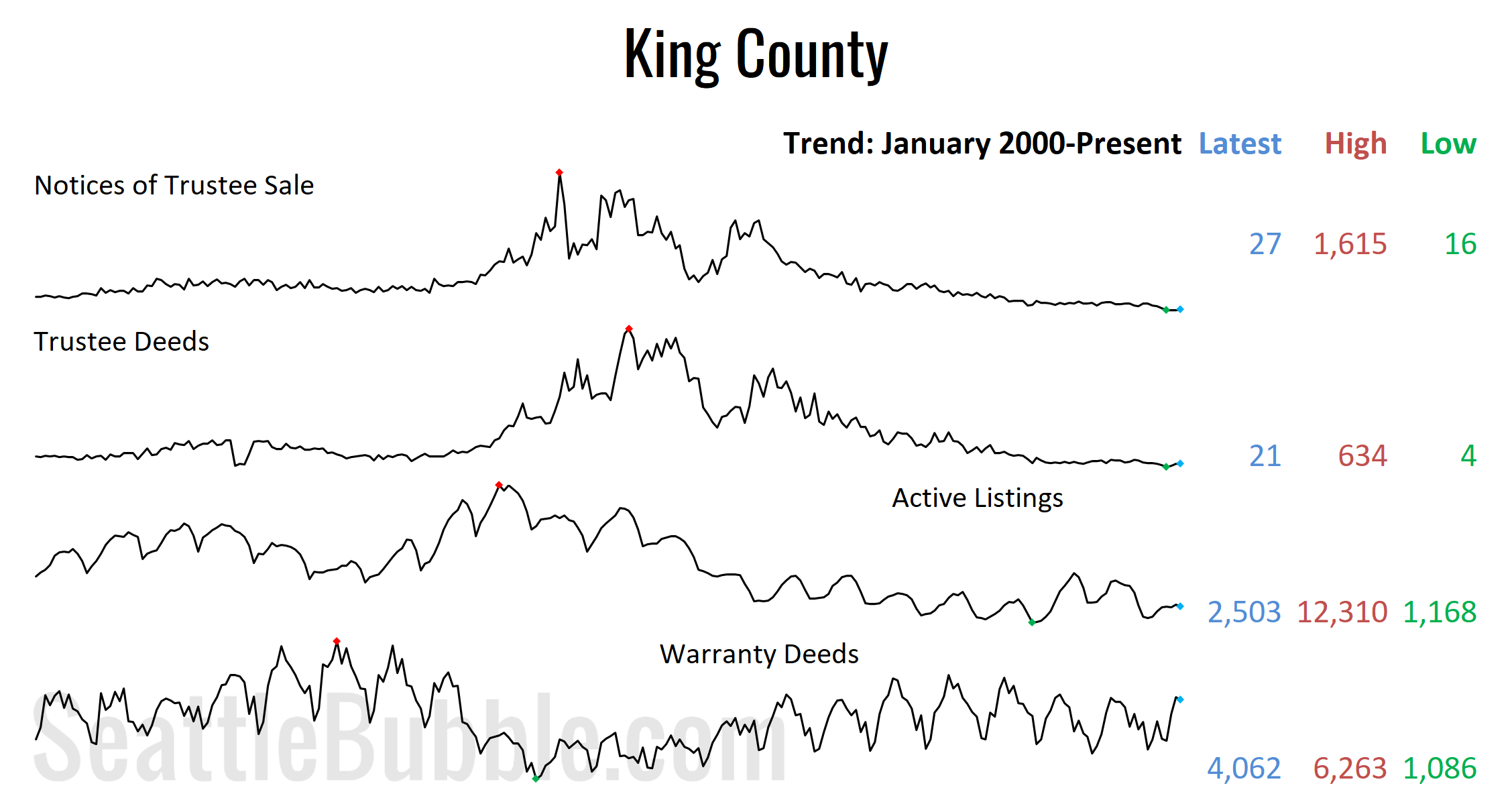
Next, here’s Notices of Trustee sale, which are an indication of the number of homes currently in the foreclosure process:

King County Notices of Trustee Sale

Foreclosure notices actually declined from September, which could signal either an easing in the foreclosure “crisis” or possibly just a continued lag as the pipeline from SB 5810 continues to fill. We probably won’t really know for sure which one it is until sometime next year.

Here’s another measure of foreclosures, looking at Trustee Deeds, which is the type of document filed with the county when the bank actually repossesses a house through the trustee auction process. Note that there are other ways for the bank to repossess a house that result in different documents being filed, such as when a borrower “turns in the keys” and files a “Deed in Lieu of Foreclosure.”

King County Trustee Deeds

A new record high in October, lagging the peak month for Trustee Sale notices by four months.

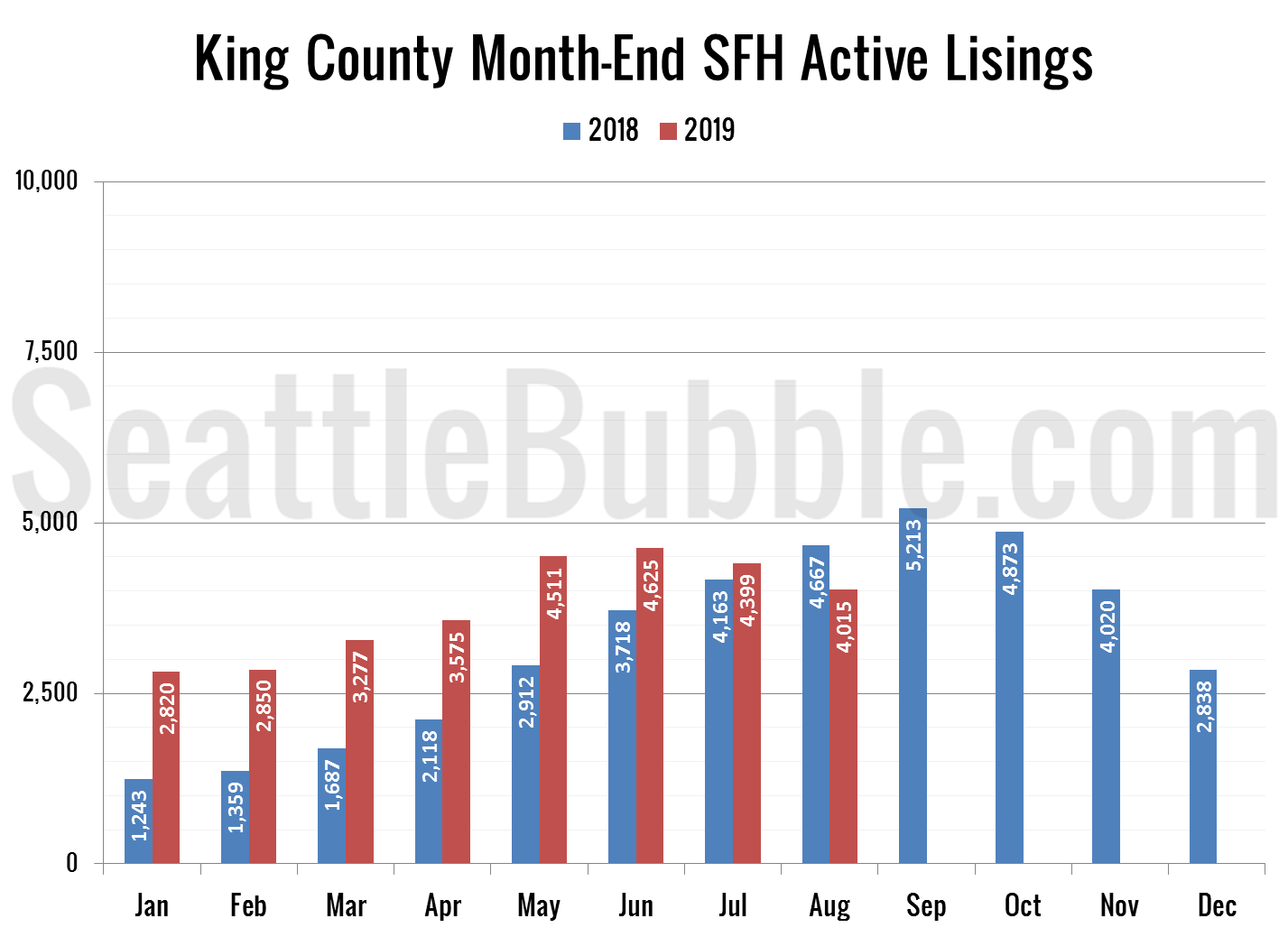
Lastly, here’s an approximate guess at where the month-end inventory was, based on our sidebar inventory tracker (powered by Estately):

King County SFH Active Listings

Looks like listings will be down around 13% year-over-year, and 6% month-to-month.

Stay tuned later this month a for more detailed look at each of these metrics as the “official” data is released from various sources.

→ 26 CommentsCategories: Statistics
Tags: , , , , , , , ,

Puget Sound Counties Interactive September Update

By The Tim on November 2nd, 2009 at 8:00 AM · 5 Comments

Whoops, sorry this is late. It took a little extra time to put together this month, as I finally switched the data over from months of supply to Seasonally Adjusted Active Supply. So, let’s have our September data checkup of NWMLS statistics from around the sound. As usual, courtesy Tableau Software, the Around the Sound update is rocking exclusive interactive data visualizations.

Feel free to download the old charts in Excel 2007 and Excel 2003 format. To get specific info about a certain point on any graph in the post below, float your mouse pointer over the data.

Before we get to the cool stuff, here’s the usual table of YOY stats for each of our seven covered counties as of September 2009.

September 2009 King Snohomish Pierce Kitsap Thurston Island Skagit Whatcom
Median Price 7.9% 11.1% 8.2% 4.6% 2.8% 1.8% 2.0% 8.7%
Listings 19.4% 23.6% 25.8% 25.1% 15.8% 2.0% 4.9% 9.7%
Closed Sales 14.3% 14.6% 12.4% 14.5% 1.5% 11.5% 20.9% 19.3%
Seasonally Adjusted Active Supply 2.0 2.1 1.8 2.0 1.9 2.5 3.0 1.5

Hit the jump for this month’s interactive charts.

[Read more →]

→ 5 CommentsCategories: Statistics
Tags: , , , , , , , , , , , , , ,

The rain returns, and with it the perfect house-shopping season.

By The Tim on October 26th, 2009 at 8:42 AM · 27 Comments

There’s no doubt that the gloomy, dark, wet weather has returned to Seattle. While everyone around Seattle retreats into the warm confines of their living rooms and local coffee shops, I’d like to offer a bit of contrarian advice for the house-shoppers out there. Seize the winter.

Winter is hands down the best time to go house hunting in Seattle, for three major reasons.

1. Less Competition

If home sales were spread evenly throughout the year, each month would see roughly 8.3% of the yearly total. Of course, anyone who has spent even a little bit of time following the real estate market knows that this is not the case. Over the last nine years, four months have consistently accounted for less than their fair share of closed sales each year: November, December, January, and February.

Monthly Percentage of Total Yearly Closed Sales: King Co. SFH 2000-2008

Keep in mind that we’re talking about closed sales, so these represent people who were house-hunting roughly a month or so earlier. In other words, if you want the least amount of competition, you should be out there looking for your next home in December or January. October and November are also good, though not quite to the same degree.

It is true that inventory also tends to decline in the winter months, giving you less selection to choose from, but sales usually decline more, as winter almost always sees the yearly highs for “months of supply” (inventory divided by sales). And less inventory isn’t necessarily a bad thing anyway, as that leads us to the second point…

2. More Motivated Sellers

How many times have you heard a hopeful seller declare as winter approaches: “I’ll just pull my house off the market for the winter and try again in the spring.” These are the kinds of houses you don’t want to buy, because the sellers are obviously not very motivated.

Typically, sellers who leave their homes on the market through the long, dark winter are those that need to sell for some reason or another, and will therefore be more likely to be willing to bargain with you.

Look for homes that have been on the market for 4-5 months in the middle of December, and you’ll probably find a highly motivated seller.

3. Easier to Spot Major Problems

In the summer, Seattle homes look great with a fresh coat of paint, the blue sky in the background providing a delightful contrast to the gleaming reflection of the sun on the bright white trim. But what you don’t see is the host of problems that may be lurking under the surface, ready to spring out the first time the rains return.

When it’s wet and rainy outside, it is far easier to spot lots of common Seattle-area house problems:

  • leaky roof
  • leaky basement / crawl space
  • mold
  • flooding / muddy yard
  • poor insulation
  • bad window or door seals

Buying a house is a major financial commitment beyond the mortgage, and it’s best to go into it knowing about these kinds of issues before they rear their ugly heads. House shopping in the pouring rain is a great way to help make sure you don’t miss something.

Seize the winter.
Obviously if everyone took this advice, some of the benefits of house-hunting in the winter would be lost. Fortunately for you, most people will continue to let things like school schedules and sunny skies dictate their house shopping plans, making the winter the perfect time for you to get the best house for the least amount of money.

→ 27 CommentsCategories: Features
Tags: , , ,

Estimating the Local Effects and Aftermath of the $8,000 Tax Credit

By The Tim on October 16th, 2009 at 6:00 AM · 60 Comments

Organizations like the National Ass. of Realtors and the National Ass. of Home Builders have been throwing around estimates of how many sales have been “stimulated” by the $8,000 tax credit nationwide, and a recent editorial by Washington State Treasurer James McIntire in favor of the inefficient, expensive, and economically stupid program throws out a number of 7,000 “stimulated” sales statewide.

How many sales locally have been “stimulated” by this ridiculous giveaway of tens of billions of dollars we don’t even have? Let’s try to see if we can estimate the number of stimulated single-family house sales for King County, using some trend analysis of closed sales data from 2000 through 2008.

2000-2009 King Co. SFH Closed SalesKing Co. SFH Closed Sales (2009 Hypothetical)

At left above is a chart that includes total closed sales each month from 2000 through 2009, with October and November data this year projected based on the May – September performance. At right above is a chart of a hypothetical “worst case” scenario of sales volume we may have seen without the influence of the $8,000 tax credit, generated by taking the average month-to-month change for each month in 2000-2008, and applying that from month to month in 2009, moving forward from the number of actual sales in April.

King Co. SFH Projected Sales: January - November 2009The “worst case” estimate at right above most likely understates the number of sales that would have taken place without the tax credit, since decreasing prices were already beginning to stimulate sales anyway, but for the sake of argument, let’s go with this estimate. Using the above estimates, we arrive at a total number of 3,850 tax credit “stimulated” sales of single-family houses in King County.

If we assume that 100% of the stimulated sales and 75% of the “worst case” baseline sales (i.e. – sales that would have happened anyway without the tax credit) were qualified first-time homebuyers, we can calculate that 11,911 sales will qualify this year for the tax credit. That’s a total cost to (future) U.S. taxpayers of over $95 million, for 3,850 “stimulated” SFH sales in King County—$25,000 per sale.

This is actually quite a bit lower than the nationwide estimates I have seen elsewhere, which put the cost per “stimulated” sale at around $43,000, which means we’re probably over-estimating the number of “stimulated” sales. With 60% as many “stimulated” sales (2,310), the cost per “stimulated” sale comes out to around $40,000.

If we assume that the lower number (2,310) is more reflective of reality and that roughly 90% of these sales were not pulled from thin air, but were in fact merely borrowed from 2010, we can calculate the approximate effect of the expiring tax credit on 2010 sales. Based on those assumptions, once the tax credit expires, we can expect sales to come in roughly 125 to 200 lower than they otherwise would have each month throughout 2010.

King Co. SFH Closed Sales (2010 Hypothetical)

Of course, that assumes that the tax credit will be allowed to expire, which is looking less and less likely. Not that extending it another six months to a year will somehow prevent the market from having to pay back the borrowed sales eventually (at a greater and greater cost the longer it is deferred), but why should pesky little economic realities prevent Congress from spending billions of additional dollars that we don’t have?

→ 60 CommentsCategories: Statistics
Tags: , , ,

September Housing Market Stats Preview

By The Tim on October 1st, 2009 at 12:12 PM · 83 Comments

With September in the bag, let’s have a look at the monthly stats preview. Most of the charts below are based on broad county-wide data that is available through a simple search of King County Records. If you have additional stats you’d like to see in the “preview,” drop a line in the comments and I’ll see what I can do.

Here’s your preview of September’s foreclosure and home sale stats:

First up, total home sales as measured by the number of “Warranty Deeds” filed with the county:

King County Warranty Deeds

County sales as measured by warranty deeds were down just slightly (0.3%) from last year in September, and actually increased month-to-month, up 7% from August. I would not be surprised to see September through November sales make a stronger showing than is usual for this time of year, with the impending expiration of the $8,000 free money giveaway pushing people who are bad at math to make a rush decision on a highly leveraged purchase.

Next, here’s Notices of Trustee sale, which are an indication of the number of homes currently in the foreclosure process:

King County Notices of Trustee Sale

September was the second-lowest month this year, but still came in higher than any month in 2008. I suspect this number will continue to rise back up to around the 1,000 mark.

Here’s another measure of foreclosures, looking at Trustee Deeds, which is the type of document filed with the county when the bank actually repossesses a house through the trustee auction process. Note that there are other ways for the bank to repossess a house that result in different documents being filed, such as when a borrower “turns in the keys” and files a “Deed in Lieu of Foreclosure.”

King County Trustee Deeds

Second-highest month on record, despite the various changes to the foreclosure process legislated earlier this year here in Washington.

Lastly, here’s an approximate guess at where the month-end inventory was, based on our sidebar inventory tracker (powered by Estately):

King County SFH Active Listings

If our tracker is close to the official numbers, inventory may actually increase slightly from August, but will still be down about 12% from last year’s level.

I don’t know about you, but there’s still nothing in these numbers that screams (or even really whispers) “imminent recovery” to me. Stay tuned later this month a for more detailed look at each of these metrics as the “official” data is released from various sources.

→ 83 CommentsCategories: Statistics
Tags: , , , , , , , ,