Seattle Bubble

News & discussion about real estate & the housing bubble in the Seattle area.

Seattle Bubble - News & discussion about real estate & the housing bubble in the Seattle area.

Entries Tagged as 'Case-Shiller'

Case Shiller Tiers: Still Looking for the Bottom

Posted by The Tim on October 1st, 2008 at 9:10 AM · 12 Comments

Let’s check out the three price tiers for the Seattle area, as measured by Case-Shiller. Remember, Case-Shiller’s “Seattle” data is based on single-family home repeat sales in King, Pierce, and Snohomish counties.
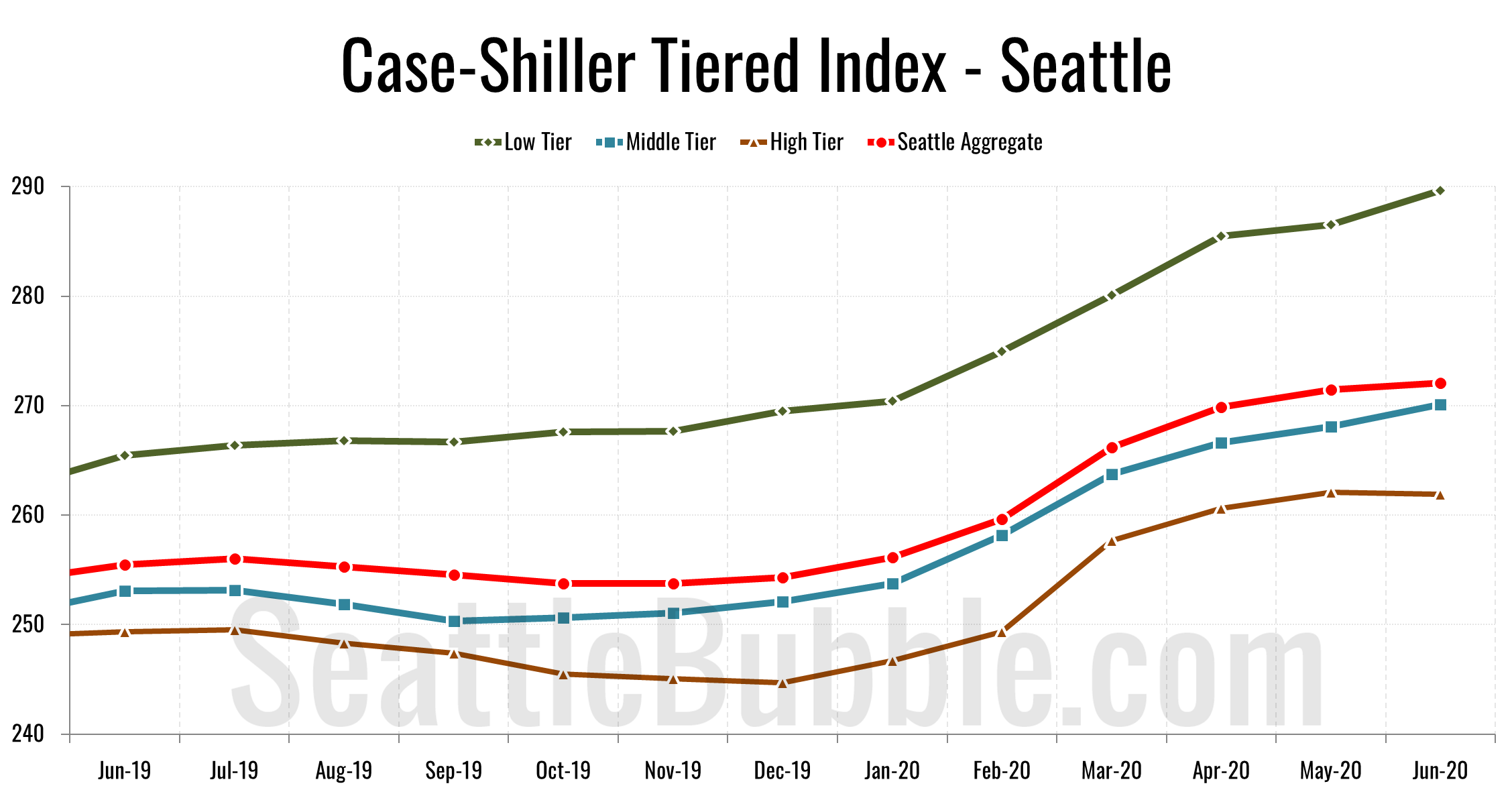
First up is the straight graph of the index from January 2000 through July 2008.

Case-Shiller Tiered Index - Seattle
Click to enlarge

Price drops have resumed in all three tiers. The low tier and mid tiers have rewound to May 2006 with the high tier performing slightly better, back to “just” June 2006. The high tier took the biggest hit in July, falling over two points, or 1.3% in one month.

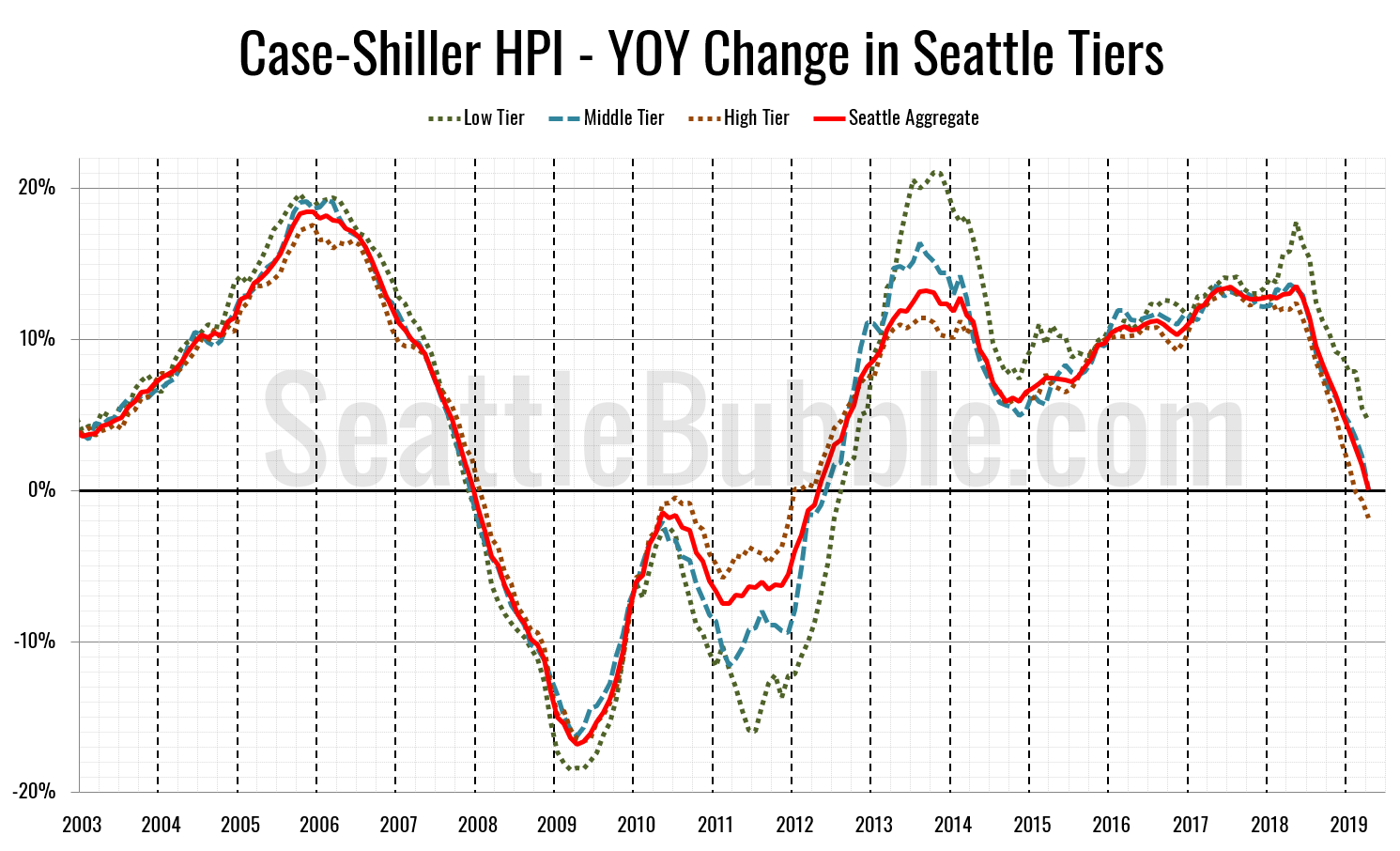
Here’s a chart of the year-over-year change in the index from July 2002 through July 2008.

Case-Shiller HPI - YOY Change in Seattle Tiers
Click to enlarge

The low tier is still seeing the biggest drops in terms of YOY performance, falling just over 9% from July 2007. Here’s where the tiers sit YOY as of July - Low: -9.3%, Med: -8.2%, Hi: -7.7%.

Lastly, here’s a decline-from-peak graph like the one posted yesterday, but looking only at the Seattle tiers.

Case-Shiller: Decline from Peak - Seattle Tiers
Click to enlarge

The high and mid tiers have fallen nearly the same amount, with the low tier resuming its drop after the flat spring “bounce.” The mid tier continues to track pretty closely with the aggregate for the whole Seattle-area market.

I guess spring wasn’t the bottom after all. At this rate, the low tier is likely to drop below 10% from peak as early as next month.

(Home Price Indices, Standard & Poor’s, 09.30.2008)

Categories: Statistics
Tags: , ,

Case-Shiller: Price Drops in Seattle Re-Accelerating

Posted by The Tim on September 30th, 2008 at 10:30 AM · 54 Comments

According to the latest data from the Case-Shiller Home Price Index, the home price bust in Seattle is gaining steam again.

Down 1.0% June to July.
Down 8.2% YOY.

Last year prices rose 0.20% from June to July, and year-over-year prices were up 6.9%.

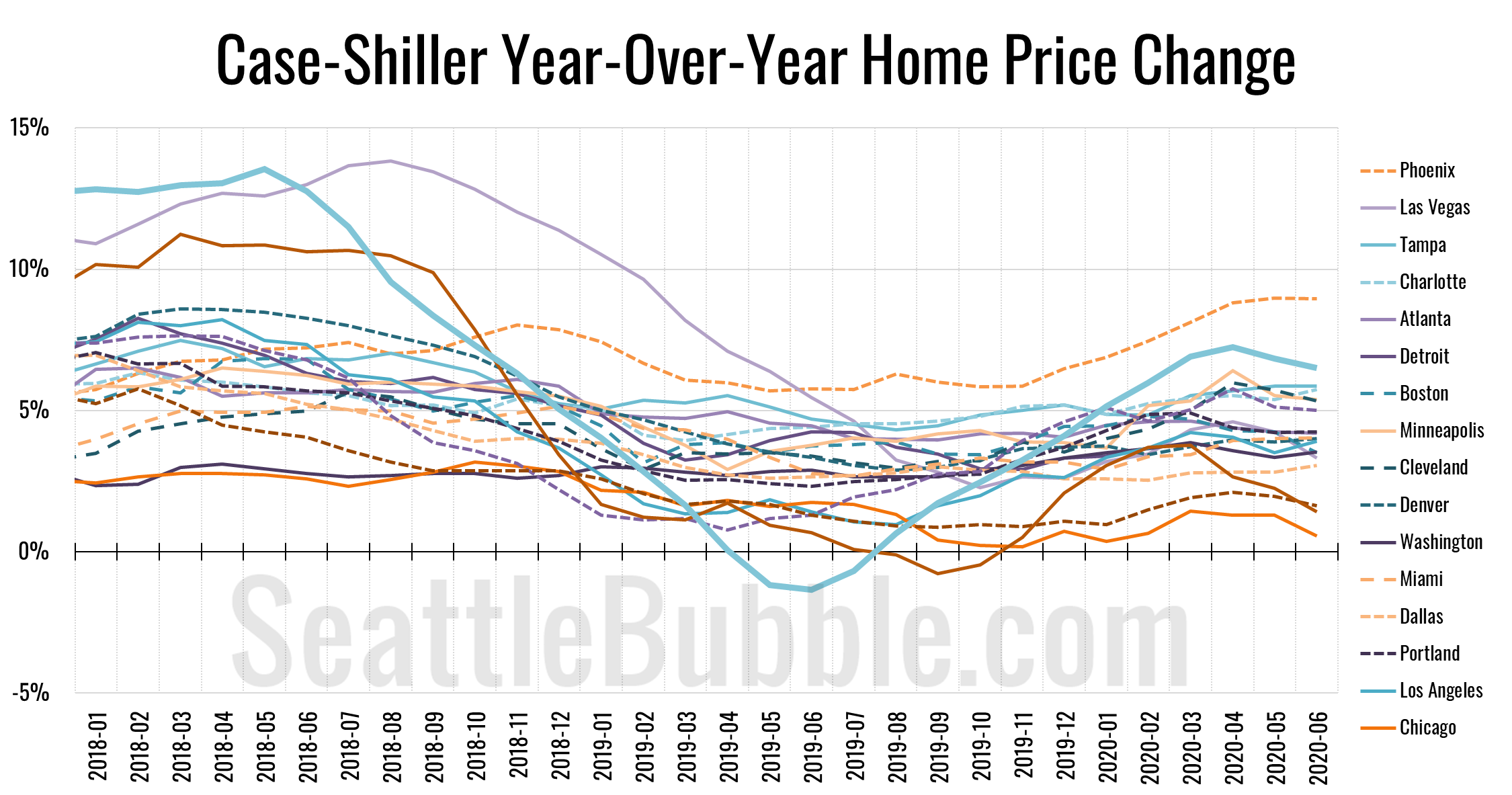
Here’s the usual graph, with L.A. & San Diego offset from Seattle & Portland by 17 months. Portland continues to experience a smaller “correction” than Seattle, falling 6.6% YOY in July.

Case-Shiller HPI: West Coast
Click to enlarge

This graph is not intended to be predictive. It is for entertainment purposes only.

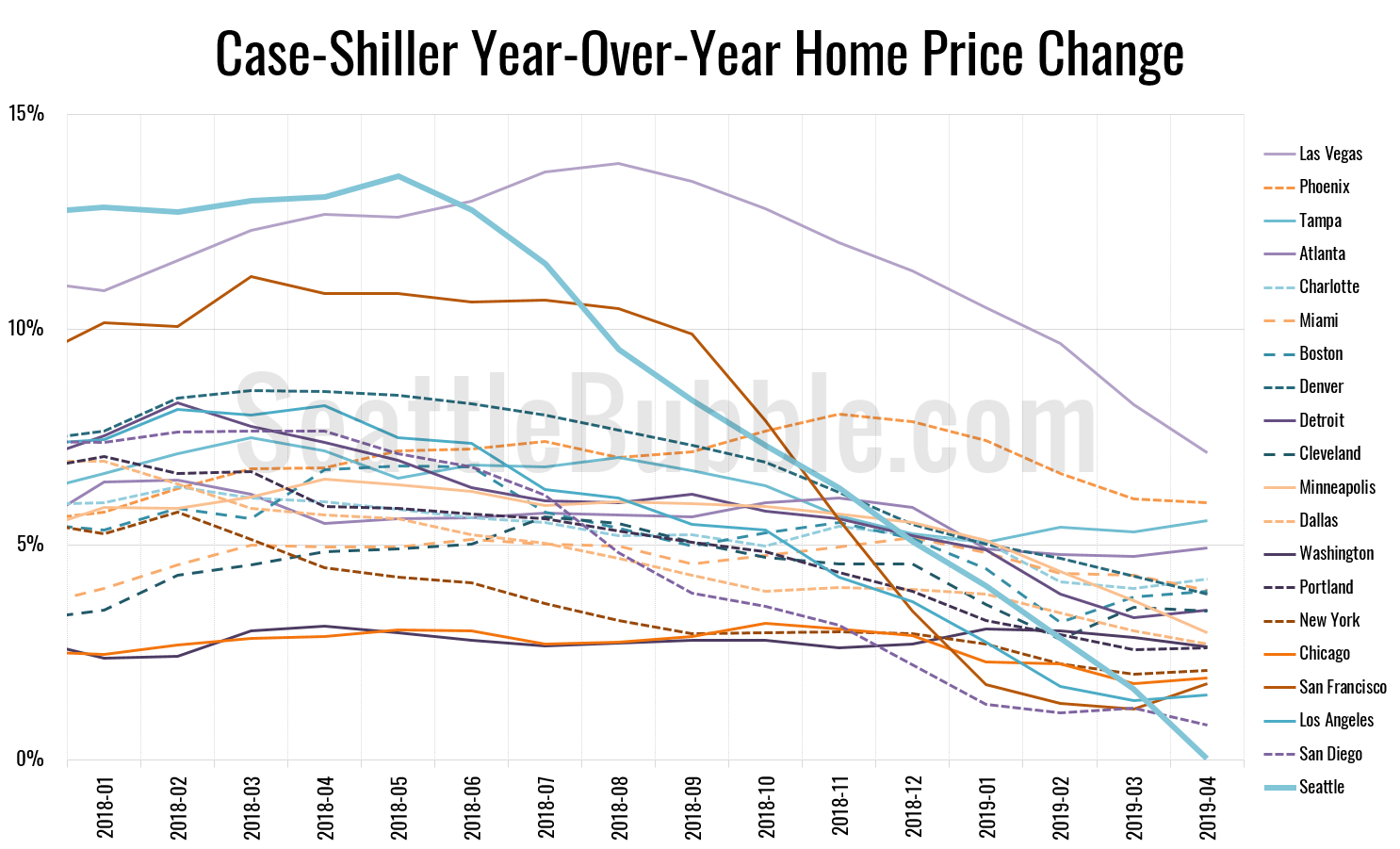
Here’s the graph of all twenty Case-Shiller-tracked cities:

Case-Shiller HPI: All Cities
Click to enlarge

In July, seven of the twenty Case-Shiller-tracked cities experienced smaller year-over-year drops than Seattle. Charlotte at -1.8%, Dallas at -2.5%, Denver at -4.7%, Boston at -5.4%, Portland at -6.7%, New York at -6.9%, and Cleveland at -8.1. The largest year-over-year drop was in Las Vegas, where prices plummeted just under 30% from July 2007.

Here’s an update to the peak-decline graph, inspired by a graph created by reader CrystalBall. This chart takes the twelve cities whose peak index was greater than 175, and tracks how far they have fallen so far from their peak. The horizontal axis shows the total number of months since each individual city peaked.

Case-Shiller HPI: Decline From Peak
Click to enlarge

It has now been exactly one year since Seattle’s Case-Shiller index peaked, and prices have declined a total of just over 8%. One year after peaking, only two other cities had declined more than Seattle has: Tampa & Miami, at 8.8% and 17.5%, respectively.

Here’s the “rewind” chart. The horizontal range is selected to go back just far enough to find the last time that Seattle’s HPI was as low as it is now. This gives us a clean visual of just how far back prices have retreated in terms of months.

Case-Shiller HPI: Seattle Price Reversion
Click to enlarge

Seattle’s Case-Shiller value for July 2008 was halfway between its May and June 2006 values. So far we are “rewound” twenty-five and a half months. The June to July drop puts Seattle at yet another new post-peak low, nearly two points lower than June.

Check back tomorrow for a post on the Case-Shiller data for Seattle’s price tiers.

(Home Price Indices, Standard & Poor’s, 09.30.2008)

Categories: Statistics
Tags: , , , ,

Case Shiller Tiers: A Flat Spring Bounce

Posted by The Tim on August 27th, 2008 at 9:54 AM · 12 Comments

Let’s check out the three price tiers for the Seattle area, as measured by Case-Shiller. Remember, Case-Shiller’s “Seattle” data is based on single-family home repeat sales in King, Pierce, and Snohomish counties.

First up is the straight graph of the index from January 2000 through June 2008.

Case-Shiller Tiered Index - Seattle
Click to enlarge

You can see that all three tiers basically flattened out through the spring. The medium and high tiers had that slight bump from March to April, but have since given back the slight gain, while the low tier has been nearly flat.

Here’s a chart of the year-over-year change in the index from June 2002 through June 2008.

Case-Shiller HPI - YOY Change in Seattle Tiers
Click to enlarge

Despite being flat for four months, the low tier continues to perform worst in terms of year-over-year price changes, coming with a nearly 9% drop from June 2007. Here’s where the tiers sit YOY as of June - Low: -8.8%, Med: -7.6%, Hi: -6.2%.

Lastly, here’s a decline-from-peak graph like the one posted yesterday, but looking only at the Seattle tiers.

Case-Shiller: Decline from Peak - Seattle Tiers
Click to enlarge

It’s almost as if the low tier is waiting for the other two tiers to catch up after dropping so severely between months 8 and 9. Looks like another month or so and the mid and high tiers should be pretty close in terms of total decline from peak.

So has the low tier bottomed out, or is the flatness of March-June just the best “spring bounce” that could be mustered? We’ll find out soon enough as we crawl into the summer and fall.

(Home Price Indices, Standard & Poor’s, 08.26.2008)

Categories: Statistics
Tags: , ,

Case-Shiller: Prices Down 7% from Last Year

Posted by The Tim on August 26th, 2008 at 9:36 AM · 60 Comments

According to the latest data from the Case-Shiller Home Price Index, the home price bust in Seattle is gaining steam again.

Down 0.2% May to June.
Down 7.1% YOY.

Last year prices rose 0.65% from May to June, and year-over-year prices were up 7.9%.

Here’s the usual graph, with L.A. & San Diego offset from Seattle & Portland by 17 months. With a drop of “just” 5.8%, Portland’s year-over-year numbers have been out-performing Seattle for seven months now.

Case-Shiller HPI: West Coast
Click to enlarge

This graph is not intended to be predictive. It’s just an interesting exercise to see how closely the Pacific Northwest is tracking the ground already covered by Southern California.

Here’s the graph of all twenty Case-Shiller-tracked cities:

Case-Shiller HPI: All Cities
Click to enlarge

Six of twenty cities experienced smaller year-over-year drops than Seattle in June. Charlotte at -1.0%, Dallas at -3.3%, Denver at -4.7%, Boston at -5.2%, Portland at -5.8%, and New York at -6.9%. The largest year-over-year drop was in Miami, where prices plummeted over 28% from June 2007. Ouch.

Here’s an update to the peak-decline graph, inspired by a graph created by reader CrystalBall. This chart takes the twelve cities whose peak index was greater than 175, and tracks how far they have fallen so far from their peak. The horizontal axis shows the total number of months since each individual city peaked.

Case-Shiller HPI: Decline From Peak
Click to enlarge

Eleven months off our peak, the drop in Seattle has improved slightly, and is now only worse than ten of the twelve “bubble cities” were at this same amount of time from their respective peaks. Only Miami and Tampa had dropped more than Seattle’s 7.3%.

Here’s the “rewind” chart. The horizontal range is selected to go back just far enough to find the last time that Seattle’s HPI was as low as it is now. This gives us a clean visual of just how far back prices have retreated in terms of months.

Case-Shiller HPI: Seattle Price Reversion
Click to enlarge

Well, we can definitely say that March wasn’t the bottom. The index for Seattle dropped to a new post-peak low in June at 178.28, just a hair below March’s value of 178.29. Prices have been holding somewhat steady at June 2006 levels for four months now. Will the summer and fall bring a continued drop, or is early summer 2006 as far as Seattle will “rewind”?

Check back tomorrow for a post on the Case-Shiller data for Seattle’s price tiers.

(Home Price Indices, Standard & Poor’s, 08.26.2008)

Categories: Statistics
Tags: , , , ,

Bubbles vs. Steady Appreciation

Posted by The Tim on August 1st, 2008 at 10:38 AM · 88 Comments

Here’s an interesting way to look at the Case-Shiller data: comparing the actual index values to theoretical values as they would look if they grew at a steady rate year-over-year.

Case-Shiller HPI and Annually Compounded Rates

The data starts in 1990 because that is the first year that the Case-Shiller index began tracking Seattle. 1990 may not be the best year to use as a baseline, since it was right at the peak of a good-sized run-up (see the 60-year Seattle home price graph), but it still gives us a good idea of where home prices would be if the appreciation curve had remained in a healthy range.

Up until about 2003, home prices in our area held pretty close to the 5% yearly appreciation curve.  At our peak, we crested just over 7% per year, and as of the latest data, Seattle’s Case-Shiller HPI sits at around 6.3% per year, or 25% above the 5% level.

For comparison, here is the same plot, but with New York, Chicago, Boston, and San Francisco added, and all cities re-indexed to 1990=100:

Case-Shiller HPI and Annually Compounded Rates

Is there some compelling argument why home prices in Seattle should be averaging around 6% per year appreciation since 1990, while values in other larger, more world-class cities are all tumbling below the 5% per year mark? If there is, I’d love to hear it. If not, I don’t see any reason to expect that prices won’t keep falling here in the Puget Sound until they are more in line with the norm.

This method was inspired by the Median House Price vs. Annually Compounded Interest tool written by regular commenter Jonness.  You can use the tool to compare hundreds of other cities in this manner. Jonness also has a number of other valuable home price comparison tools on his website HousingCorrection.com.

Categories: Statistics
Tags: , ,

Comparing Boom and Bust Cycles Across Markets

Posted by deejayoh on July 31st, 2008 at 11:38 AM · 53 Comments

The point has been made many times here that exposure to downturns needs to be viewed in the context of how much a market rose during the boom.  I thought it would be interesting to test this by comparing the total percentage gain during the boom years to the total percentage drop from peak to date across a bunch of markets, to see if I could establish a clear relationship or correlation between the two.

For the purposes of this comparison, I used the following definitions:

  • “Boom” returns are the total appreciation between 09/2001 (based on the oft cited relationship between the Fed taking down short term lending rates and the housing boom) and the peak for each market.
  • “Bust” returns are the total decline from peak to the latest reported numbers.

I used the Case-Shiller report for May as the source of all the numbers. The results are kind of interesting:

Boom and Bust Cycles
Click to enlarge

This snapshot does appear to support the assertion that there is a good correlation between boom and busts cycles across markets -and that generally speaking,  the more you go up, the more you go down. But there appear to be outliers versus the trend: Namely, Detroit on the down side, and Seattle, Portland, Charlotte, and possibly New York on the up side. This is interesting to me because the relationship between up and down markets is usually cited as evidence that the Seattle market will remain relatively stable compared to other markets - when according to this view, we appear to be bucking the trend and perhaps poised for a fall.  We are down 7% to date when the trend line suggests we should be off 15-20%

What does it mean?  Who knows. There isn’t any hard and fast rule that says every market must follow all other markets, but the inverse relationship between booms and busts does appear to be pretty strong. And it certainly is the case that Seattle has not seen as much “bust” as would be expected when compared to all other markets.

Categories: Features · Statistics
Tags: , ,