Seattle Bubble

News & discussion about real estate & the housing bubble in the Seattle area.

Seattle Bubble - News & discussion about real estate & the housing bubble in the Seattle area.

Entries Tagged as 'downtown'

Weekend News Roundup

By The Tim on July 6th, 2009 at 8:00 AM · 18 Comments

Lots of local real estate related news over the weekend worth mentioning. Here’s a brief roundup of the stories you might be interested in.

Let’s kick things off with some good news via Aubrey Cohen at the P-I. Looks like the state’s irresponsible plan to pre-distribute $8,000 tax credit is dead in the water, thanks to the IRS.

SeattlePI.com: State clarifies state of tax credit loan plan

There has been a lot of information circulating in the past few months regarding a possible Tax Credit bridge loan program that would have potentially “monetized” the currently available $8,000 federal tax credit for qualified first time homebuyers. This potential program would have allowed these first time homebuyers to actually come to the closing table with their credit in hand, as opposed to waiting to have these funds available until after closing.

On June 2, 2009, the IRS formally declined this request citing long-standing regulations requiring refunds be paid only to the person or persons filing the tax return. Due to significant financial risks associated with the Tax Credit bridge loan program and recent guidance published from the Department of Housing and Urban Development, the Commission discontinued the development of the Tax Credit bridge loan program.

Next up, a bit of humor from SmartMoney.com, who you may recall last October labeled Seattle as “in the best shape for a rebound.”

SmartMoney.com: 5 Housing Markets That Have Further to Fall

In the Northwest, median home prices are down but they remain above the national average. Portland’s prices fell 2.1% in March. Home prices in Seattle were down 2.0% for the month.

The Pacific Northwest bubble was among the last to burst, which could mean the market will be among the last to recover.

And here’s a handful of additional stories for you to digest this post-holiday Monday morning…

Seattle Times: Landmark Smith Tower mostly vacant

Thanks to the recession and Washington Mutual’s collapse, there’s no shortage of vacant office space in downtown Seattle. One of the emptiest buildings also is one of the region’s best-known and most-loved.

The 95-year-old Smith Tower, once the tallest building west of Chicago, is at least 70 percent vacant, according to online listings and commercial real-estate databases.

Walton Street bought the 257,000-square-foot Smith Tower for $43 million in April 2006, when the market was nearing its peak and the tower was 92 percent occupied, according to its previous owner.

Less than a year later the new owner sought — and ultimately received — city approval to convert the entire building to condos, a move prompted, in part, by the impending departure of the tower’s two largest office tenants.

When the downtown condo market began to cool later in 2007, Walton Street scaled back its condo-conversion plans to just the top 12 stories.

But it hasn’t pursued permits for that scenario for more than a year, city records indicate.

The Smith Tower has always been my favorite building in downtown Seattle. It’s a shame to see it sit unused like this. I actually like the idea of converting it to condos, although I’m not sure there would be all that much appeal to live in Pioneer Square…

Seattle Times: Lynnwood’s City Bank gets tighter scrutiny

City Bank of Lynnwood, hurt by heavy lending to developers and homebuilders, on Thursday became the latest local bank to submit to tighter oversight from federal and state regulators.

It signed an agreement, called a cease-and-desist order, that requires City Bank to shrink the volume of nonperforming loans and foreclosed real estate it’s carrying on its books; reduce its dependence on brokered deposits; increase its capital levels; and make other operational and organizational changes.

Puget Sound Business Journal: Lexas believes condo buyers will show up

Call him a contrarian. Escala developer Eric Midby expects to move ahead with a pair of high-rise hotel and condominium towers at a time when nearly every other developer has decided to sit out this market because of the recession.

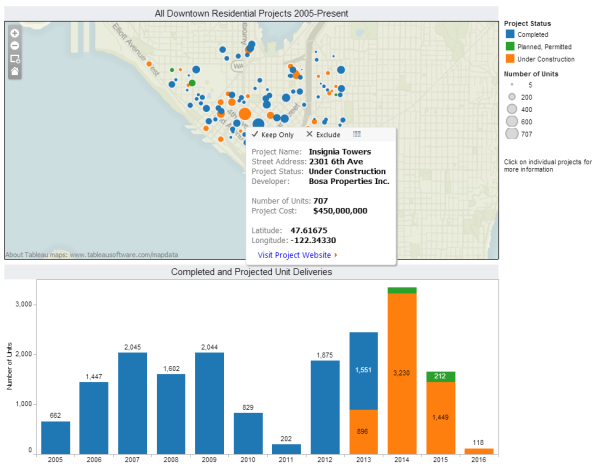
Midby, a principal and development manager at Lexas Cos., is betting that by getting the company’s next condo project under way now, he can exploit a two-year gap in the delivery of new condominium units in downtown Seattle that starts next year.

“We firmly believe that Seattle very soon is going to have a shortage of housing, that all the units in downtown will fill up and there will be continued demand,” Midby said.

Seattle Times: Property taxes: Appeals shoot up is King, Snohomish Counties

Homeowners complained in near-record numbers about high valuations last year. Appeals of property values shot up more than threefold in King County, from 3,767 in 2007 to 13,156 in 2008. The last time there were that many appeals was 1991, when a sluggish real-estate market followed several years of rapidly climbing home values.

Appeals also increased in Snohomish County last year — from 1,688 to 2,347.

Appeals resulted in lowered values about half the time in King County and about a third of the time in Snohomish County, according to the assessors.

I remind any Seattle Bubble readers that are considering appealing their assessment that S-Crow posted a useful “how-to” on this process that would be a good starting point.

West Seattle Blog: City Council townhouse talk in West Seattle: Less (rules) is more?

…As in, less (fewer) restrictions could mean more variety in housing units. Or, so said the architects from whom City Councilmember Sally Clark and her Planning, Land Use and Neighborhoods Committee heard at Youngstown Arts Center Tuesday night.

The West Seattle meeting addressed only a slice of the Multi-Family Code Update, townhouses and “low-rise” zoning in particular.

And finally, here’s a national story on the subject of “strategic defaults,” which we have been discussing lately.
Wall Street Journal: New Evidence on the Foreclosure Crisis

What is really behind the mushrooming rate of mortgage foreclosures since 2007? The evidence from a huge national database containing millions of individual loans strongly suggests that the single most important factor is whether the homeowner has negative equity in a house — that is, the balance of the mortgage is greater than the value of the house. This means that most government policies being discussed to remedy woes in the housing market are misdirected.

…the focus on subprimes ignores the widely available industry facts (reported by the Mortgage Bankers Association) that 51% of all foreclosed homes had prime loans, not subprime, and that the foreclosure rate for prime loans grew by 488% compared to a growth rate of 200% for subprime foreclosures.

…although only 12% of homes had negative equity, they comprised 47% of all foreclosures.

Yow.

→ 18 CommentsCategories: News
Tags: , , , , , , , , , ,

Two Recent KUOW Pieces of Note

By The Tim on June 22nd, 2009 at 1:02 PM · 32 Comments

Thanks to everyone who responded to the call earlier this month from KUOW for help on their story about the soft market.

Here’s the resulting piece: It’s a Tenants Market for Downtown Seattle Office Space

There may be signs of recovery in the region’s housing market, but not so for the region’s office market. A recent survey from Price Waterhouse Coopers says commercial property values in Seattle are expected to decline up to 15 percent this year, that’s more than the national average. The survey predicts the market will remain in recession for two more years.

[Large downtown Seattle landlord UNICO's Chief Financial Officer John] Lamb says it’s going to be a while before the market begins to stabilize. He says vacancy rates will continue to rise, and don’t be surprised if some commercial office buildings in Seattle end up facing foreclosure.

Also, last Friday’s “weekday” discussed the residential market, with : Short Sales, Foreclosures and First Time Home Buyers

Friday’s program had the same guests that were on the program in early May that we mentioned here: real estate agent / appraiser Richard Hagar, Urban League housing director Linda Taylor, as well as new guest certified financial counselor Andrea Misiano.

They discuss foreclosure / refinancing rescue scams, including some good advice for first-time buyers—take the emotion out of the home-buying process. I haven’t been able to listen to the entire program, but apparently there was also some questionable advice mixed in this time, including the claim that (according to a Seattle Bubble reader) “it’s better to get the low interest rate than the “one-time” lower house price.” In any case it’s overall worth a listen when you can make the time.

Kudos to KUOW for continuing to give the local real estate market some decent, thoughtful coverage that goes beyond the usual “ra-ra” pro-industry pieces that have been all-too-common in most news sources.

→ 32 CommentsCategories: News
Tags: , , , , , , ,

Walking Away at Olive8

By The Tim on May 4th, 2009 at 10:04 AM · 41 Comments

We made a passing mention of Olive8 pre-sale buyers walking away from their deposits in the condo sales status project post (which is still being compiled, by the way), and a week or so ago the Seattle Times posted a story about buyers at Olive8 and elsewhere walking away.

On Saturday local entrepreneur Andy Liu posted his personal story of walking away from Olive8: My $23,750 Mistake at Olive 8

A couple years back in 2006, I made the decision to put down a deposit pre-sale for one of the new condo projects in Seattle. In retrospect, it turned out to be a big mistake. Although I haven’t yet walked away from the deal yet since the closing date is still a few weeks away, it is almost certain that I will walk and lose my earnest money in the deal which totals $23,750. Although I’ve read about folks who are trying to get some of their earnest money back, in my mind, a deal is a deal, and I lost so I won’t be pursuing any of the earnest money. It’s a bummer, but I’m here to share my lessons learned.

Part of me just wants to go ahead with the purchase because I had already committed $23,750 to it, but it makes no logical sense. I’m only amplifying the mistake and hoping to hit a homerun to recover that mistake. Instead of amplifying the mistake, I need to let it go. Once you’ve realized you made a mistake, learn from it and move on, there are plenty of opportunities tomorrow.

This is a great writeup by Andy. I really appreciate him sharing his story. If you’re interested in getting a look at what’s going on inside the head of people that are making the tough decisions in the market right now, you should definitely read the whole thing.

→ 41 CommentsCategories: News
Tags: , ,

JPMorgan to Drop WaMu Leases Downtown

By The Tim on December 24th, 2008 at 10:29 AM · 28 Comments

Here’s another WaMu update on a subject that will likely have a large impact on downtown’s commercial real estate scene:

Seattle Times: JPMorgan dumping WaMu’s leased space in Seattle
Seattle P-I: JPMorgan dropping six WaMu leases in Seattle

From the P-I story:

New York banking giant JPMorgan Chase & Co., which in September bought the branches, deposits and loans of Washington Mutual Inc. of Seattle for $1.9 billion, plans to drop the leases in six downtown office buildings now housing WaMu employees, a WaMu spokeswoman said.

WaMu currently leases about 880,000 square feet in downtown Seattle, said Patrick Mullen, a research analyst with Grubb & Ellis Co., Seattle.

“Assuming Chase lets go of most of the workers in those leased offices, and then lets go of the offices, that event alone could drive up vacancies 2 to 3 percentage points in the central business district,” Mullen said. “It would depress rent rates even more than they are now.”

Mullen said the massive withdrawal could also undercut the roughly 2.5 million square feet of office space due for completion in downtown Seattle next year.

Also, from the Times story:

It also decided WaMu’s Cedarbrook corporate-training center in SeaTac is “not a core asset for us, and we are looking at options for it,” said JPMorgan spokesman Thomas Kelly.

Now is not a particularly great time to be in the commercial real estate business in downtown Seattle.

(Melissa Allison and Eric Pryne, Seattle Times, 12.24.2008)
(Dan Richman, Seattle P-I, 12.23.2008)

→ 28 CommentsCategories: News
Tags: , , , , , , , ,

“Out here in Seattle, we were living in a bubble.”

By The Tim on October 21st, 2008 at 5:00 PM · 13 Comments

These articles are a bit off-topic from the usual news about residential real estate, but I thought they were at least worth a brief mention.

New York Times: In Seattle, Office Vacancy Rate Is Rising Fast

Not long ago, Seattle looked invincible, even as an economic downturn was starting to plague the rest of the country.

High-profile Seattle-area companies like Microsoft and Amazon were adding thousands of jobs, trade with Asia was strong and Boeing was selling thousands of commercial jets. Deemed the best office market in the country in some nationwide reports, the city was attracting real estate investors hungry to buy office buildings and build new projects. It seemed as if nothing could go wrong.

“Out here in Seattle, we were living in a bubble, immune from the rest of the country,” said Bruce Blume, founder of a real estate development firm, the Blume Company.

It was like they thought there was some kind of Seattle… Bubble or something.

The vacancy rate for office space in the central business district reached 10 percent in the third quarter, according to Cushman & Wakefield, still below the nationwide average, but up from 8.4 percent a year ago.

With five new buildings, encompassing about two million square feet, opening next year, the vacancy rate is expected to hit 15 percent. Most of the new space has not been leased.

Sales of office buildings reached $11.47 billion in 2007, some seven times what they were in 2004, according to Real Capital Analytics. Deals so far this year have totaled only $375 million.

Although building prices have tumbled in 2008, it hasn’t been enough to keep investors interested. Since last year, the price to acquire office space has shrunk 32 percent, to an average of $227 a square foot, according to Real Capital Analytics.

From the sounds of it, the commercial real estate market around here is actually getting hit harder and faster than the residential market.

Then again, maybe not? Here’s a competing headline from today’s Seattle Times: Seattle’s commercial real-estate market is No. 1 for 2009

Seattle is the No. 1 commercial real-estate investment market in the country for 2009 — even though it’s in worse shape than a year ago, a new forecast concludes.

It rose to the top spot only because other markets are expected to suffer more from the economic downturn, the report’s authors said.

The forecast, “Emerging Trends in Real Estate 2009,” was released today by the Urban Land Institute and PriceWaterhouseCoopers. It bases its assessment of the overall commercial real-estate situation and individual markets on surveys and interviews with about 700 developers, investors, lenders, brokers and other professionals.

Hmm. I wonder if the data for this report was collected before or after WaMu was bought out and Microsoft announced they were “re-evaluating [their] current hiring plans.”

(Kristina Shevory, New York Times, 10.21.2008)
(Eric Pryne, Seattle Times, 10.21.2008)

→ 13 CommentsCategories: News
Tags: , , , , , ,

Big Downtown Land Deal Evaporates

By The Tim on April 25th, 2008 at 2:34 PM · 18 Comments

Almost a year ago, a family that has accumulated ownership of 13 near-contiguous acres of downtown real estate in the Denny Triangle finally put the whole lot of it on the market.

Clise PropertyMr. Clise is convinced now is the ideal time to sell. The job-market outlook is robust for Seattle, and the office market, with a low 5% vacancy rate for top-quality “Class A” buildings, is hungry for more space, says Michel Seifer, managing director of capital markets for Jones Lang LaSalle, the real-estate-services firm handling the sale.

Yet, there is a possibility that Mr. Clise, age 57, may have missed his window. Increases in the cost of borrowing — with the yield on the benchmark 10-year Treasury note rising to nearly 5.25% last week — could keep some previously active real-estate investors on the sidelines for this blockbuster, but inherently risky, transaction. Mr. Clise says if he doesn’t get the price he is seeking for the land — well into the hundreds of millions of dollars — he could still take it off the market.

Well, as reported by the Wall Street Journal yesterday (subscription), and picked up by the Seattle Times and Seattle P-I today, it looks like they were indeed a bit too late:

In retrospect, Clise said, the family should have begun marketing the property a year earlier, before the credit crisis deepened.
- Seattle Times

“Large real estate deals are not being financed right now,” Clise Properties Chief Executive Alfred Clise said Thursday afternoon.

Frank Bosl, a senior vice president in the Seattle office of CB Richard Ellis, said the move makes sense.

“The changes in the financial market are causing the capital for doing deals to be out of sync with the value of the real estate right now,” he said.
- Seattle P-I

Some see this as a portent of a growing trend in commercial real estate, heading into a downturn 12-18 months after residential. Personally I don’t follow commercial real estate really at all, so I wouldn’t attempt to derive any sort of market meaning out of this move.

Does anyone here deal a lot with commercial real estate? Have you seen a significant slowdown there, too? Or was the failure of this deal more a result of its massive size?

Story tip: Deejayoh’s forum post

(Jennifer S. Forsyth, Wall Street Journal, 06.18.2007)
(Jennifer S. Forsyth, Wall Street Journal, 04.25.2008)
(Eric Pryne, Seattle Times, 04.25.2008)
(Aubrey Cohen, Seattle P-I, 04.24.2008)

→ 18 CommentsCategories: News
Tags: , , , ,